

Full 070-768 Practice Test and 70 unique questions with explanations waiting just for you!
MCSA Dumps 070-768 Exam for Full Questions - Exam Study Guide
NEW QUESTION 21
Note: This question is part of a series of questions that present the same scenario. Each question in the series contains a unique solution. Determine whether the solution meets the stated goals.
You deploy a tabular data model to an instance of Microsoft SQL Server Analysis Services (SSAS). The model uses an in-memory cache to store and query data. The data set is already the same size as the available RAM on the server. Data volumes are likely to continue to increase rapidly.
Your data model contains multiple calculated tables.
The data model must begin processing each day at 2:00 and processing should be complete by 4:00 the same day. You observe that the data processing operation often does not complete before 7:00. This is adversely affecting team members.
You need to improve the performance.
Solution: Install solid-state disk drives to store the tabular data model.
Does the solution meet the goal?
- A. No
- B. Yes
Answer: A
Explanation:
By default, tabular models use an in-memory cache to store and query data. When tabular models query data residing in-memory, even complex queries can be incredibly fast.
However, there are some limitations to using cached data. Namely, large data sets can exceed available memory, and data freshness requirements can be difficult if not impossible to achieve on a regular processing schedule.
DirectQuery overcomes these limitations while also leveraging RDBMS features making query execution more efficient.
With DirectQuery: +
References:https://docs.microsoft.com/en-us/sql/analysis-services/tabular- models/directquery-mode-ssas-tabular
NEW QUESTION 22
You are building a Microsoft SQL Server Analysis Services multidimensional model over a SQL Server database.
In a cube named OrderAnalysis, there is a standard cube dimension named Stock Item.
This dimension has the following attributes:
Users report that the attributes Stock Item Key and Photo are distracting and are not providing any value.
They have asked for the attributes to be removed. However, these attributes are needed by other cubes.
You need to hide the specified attributes from the end users of the OrderAnalysis cube. You do not want to change the structure of the dimension.
Which change should you make to the properties for the Stock Item Key and Photo attributes?
- A. Set the AttributeHierarchyEnabledproperty to False.
- B. Set the AttributeVisibility property to Hidden.
- C. Set the Usage property to Regular.
- D. Set the AttributeHierarchyVisible property to False.
- E. Set the AttributeHierarchyDisplayFolder property to Hidden.
Answer: D
Explanation:
The value of the AttributeHierarchyEnabled property determines whether an attribute hierarchy is created. If this property is set to False, the attribute hierarchy is not created and the attribute cannot be used as a level in a user hierarchy; the attribute hierarchy exists as a member property only. However, a disabled attribute hierarchy can still be used to order the members of another attribute. If the value of the AttributeHierarchyEnabled property is set to True, the value of the AttributeHierarchyVisible property determines whether the attribute hierarchy is visible independent of its use in a user-defined hierarchy.
https://technet.microsoft.com/en-us/library/ms166717(v=sql.110).aspx
NEW QUESTION 23
DRAG DROP
You are a business analyst for a company that uses a Microsoft SQL Server Analysis
Services (SSAS) tabular database for reporting. The database model contains the following tables:
You have been asked to write a query for a report that returns the total sales for each product subcategory, as well as for each product category.
You need to write the query to return the data for the report.
How should you complete the DAX statement? To answer, drag the appropriate DAX segment to the correct locations. Each DAX segment may be used once, more than once, or not at all. You may need to drag the split bar between panes or scroll to view content.
Answer:
Explanation:
Explanation:
Box 1:EVALUATE
Box 2:SUMMERIZE
Box 3:ROLLUP
Box 4:'Product Subcategory' ['Product Subcategory Name]
Note: The behavior of SUMMARIZE is similar to the GROUP BY syntax of a SELECT statement in SQL. For example, consider the following query.
EVALUATE
SUMMARIZE(
'Internet Sales',
'Internet Sales'[Order Date],
"Sales Amount", SUM( 'Internet Sales'[Sales Amount] )
)
This query calculates the total of Sales Amount for each date in which there is at least one order,
producing this result.
References:
NEW QUESTION 24
DRAG DROP
You are a business analyst for a company that uses a Microsoft SQL Server Analysis Services (SSAS) tabular database for reporting. The database model contains the following tables:
You have been asked to write a query for a report that returns the total sales for each product subcategory, as well as for each product category.
You need to write the query to return the data for the report.
How should you complete the DAX statement? To answer, drag the appropriate DAX segment to the correct locations. Each DAX segment may be used once, more than once, or not at all. You may need to drag the split bar between panes or scroll to view content.
Select and Place:
Answer:
Explanation:
Explanation/Reference:
Note: The behavior of SUMMARIZE is similar to the GROUP BY syntax of a SELECT statement in SQL.
For example, consider the following query.
EVALUATE
SUMMARIZE(
'Internet Sales',
'Internet Sales'[Order Date],
"Sales Amount", SUM( 'Internet Sales'[Sales Amount] )
)
This query calculates the total of Sales Amount for each date in which there is at least one order, producing this result.
Reference: https://msdn.microsoft.com/en-us/library/gg492171.aspx
NEW QUESTION 25
You are designing a SQL Server Analysis Services (SSAS) cube.You need to create a measure to count unique customers.What should you do?
- A. Create a dimension. Then add a cube dimension and link it several times to the measure group.
- B. Add a hidden measure that uses the Sum aggregate function. Add a calculated measure aggregating the measure along the time dimension.
- C. Add a measure that uses the LastNonEmpty aggregate function. Use a regular relationship between the time dimension and the measure group.
- D. Create several dimensions. Add each dimension to the cube.
Answer: C
NEW QUESTION 26
You are developing a tabular Business Intelligence Semantic Model (BISM) database based on a SQL Server database.
In the data source, the FactInternetSales table is partitioned by month. Data from the current month has been updated and new data has been inserted in the FactInternetSales table, in the DimProduct table, and in the DimCustomer table.
In the model, the FactInternetSales table is also partitioned by month. You need to ensure that the model has the most recent data while minimizing the processing time.
What should you do?
- A. Process the latest FactInternetSales model table partition, the DimProduct table, and the DimCustomer table with the Process Clear processing option. Then process the database with the Process Data processing option.
- B. Process the latest FactInternetSales model table partition, the DimProduct table, and the DimCustomer table with the Process Data processing option. Then process the database with the Process Recalc processing option.
- C. Process the latest FactInternetSales model table partition, the DimProduct table, and the DimCustomer table with the Process Data processing option. Then process the database with the Process Defrag processing option.
- D. Process the latest FactInternetSales model table partition, the DimProduct table, and the DimCustomer table with the Process Defrag processing option. Then process the database with the Process Recalc processing option.
- E. Process the latest FactInternetSales model table partition, the DimProduct table, and the DimCustomer table with the Process Clear processing option. Then process the database with the Process Full processing option.
Answer: C
NEW QUESTION 27
Note: This question is part of a series of questions that present the same scenario. Each question in the series contains a unique solution. Determine whether the solution meets the stated goals.
You have an existing multidimensional cube that provides sales analysis. The users can slice by date, product, location, customer, and employee.
The management team plans to evaluate sales employee performance relative to sales targets. You identify the following metrics for employees:
You need to implement the KPI based on the Status expression.
Solution: You design the following solution:
Does the solution meet the goal?
- A. No
- B. Yes
Answer: A
NEW QUESTION 28
HOTSPOT
A company has a multidimensional cube that is used for analyzing sales data. You add a new measure named Transaction - Total Including Tax and include the Supplier, Payment
Method, and Transaction Type dimensions in the data model. The Transaction - Total
Including Tax measure uses the existing Customer and Date dimensions.
When users have queried the new measure in the past, they saw results as shown in the existing query output exhibit. (Click the Exhibit button.)
The overall total is incorrectly displayed on every row. In addition, the results are no longer formatted correctly.
The query result should appear as shown in the desired query output exhibit. (Click the
Exhibit button.)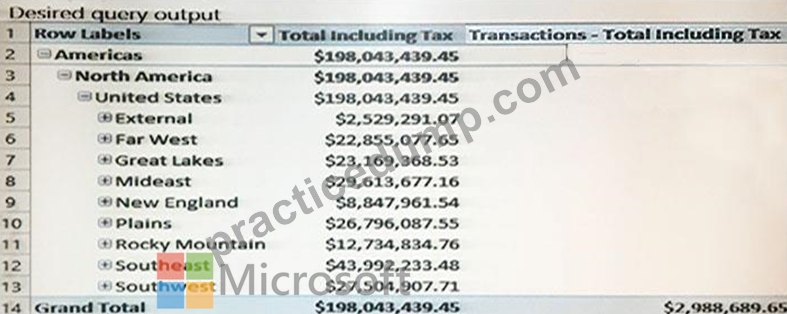
You need to ensure the table is displayed correctly.
What should you do? Use drop-down menus to select the answer choice that answers each question based on the information presented in the graphic.
NOTE: Each correct selection is worth one point.
Answer:
Explanation:
Explanation:
Box 1: Enter a custom MeasureExpression property on the measure
Calculated measures use MDX expressions to supply their values, instead of binding to columns in a data source. The Expression property contains the MDX expression used to supply the values for a Measure only if the Measure is a calculated measure. Otherwise, this property contains an empty string ("").
NEW QUESTION 29
A database named DB2 uses the InMemory query mode. Users frequently run the following query:
You need to ensure no users see the PriorYearSales measure in the field list for the Sales table.
What should you do?
- A. Create a perspective, and ensure that the PriorYearSales measure is not added to the perspective. Ensure that users connect to the model by using the perspective.
- B. Set the Display Folder property for PriorYearSales toHidden.
- C. Remove the PriorYearSales measure from the default field set of the Sales table.
- D. Create a role using Read permissions, and define a DAX expression to filter out the PriorYearSales measure. Add all users to the role.
Answer: A
Explanation:
Using perspectives in the data model might help you expose a subset of tables, columns, and measures that are useful for a particular type of analysis.
Usually, every user needs only a subset of data you create, and showing him or her the model through perspectives can offer a better user experience.
From scenario; The PriorYearSales measure is referenced by other measures, and is not intended to be analyzed directly by users.
References: Microsoft SQL Server 2012 Analysis Services, The BISM Tabular Model, Microsoft Press (July 2012), page 305 Topic 4, Mix Questions
NEW QUESTION 30
You need to configure the server to optimize the afternoon report generation based on the OrderAnalysis cube.
Which property should you configure?
- A. LowMemoryLimit
- B. VirtualMemoryLimit
- C. TotalMemoryLimit
- D. VertiPaqPagingPolicy
Answer: A
Explanation:
LowMemoryLimit: For multidimensional instances, a lower threshold at which the server first begins releasing memory allocated to infrequently used objects.
From scenario: Reports that are generated based on data from the OrderAnalysis cube take more time to complete when they are generated in the afternoon each day. You examine the server and observe that it is under significant memory pressure.
===============================================
Topic 2, Case Study #2
Background
Wide World Importers has multidimensional cubes named SalesAnalysis and ProductSales. The SalesAnalysis cube is refreshed from a relational data warehouse. You have a Microsoft SQL Server Analysis Services instance that is configured to use tabular mode. You have a tabular data model named CustomerAnalysis.
Sales Analysis
The SalesAnalysis cube contains a fact table named CoffeeSale loaded from a table named FactSale in the data warehouse. The time granularity within the cube is 15 minutes.
The cube is processed every night at 23:00. You determine that the fact table cannot be fully processed in the expected time. Users have reported slow query response times.
The SalesAnalysis model contains tables from a SQL Server database named SalesDB.
You set the DirectQueryMode option to DirectQuery. Data analyst access data from a cache that is up to 24 hours old. Data analyst report performance issues when they access the SalesAnalysis model.
When analyzing sales by customer, the total of all sales is shown for every customer, instead of the customer's sales value. When analyzing sales by product, the correct totals for each product are shown.
Customer Analysis
You are redesigning the CustomerAnalysis tabular data model that will be used to analyze customer sales. You plan to add a table named CustomerPermission to the model. This table maps the Active Directory login of an employee with the CustomerId keys for all customers that the employee manages.
The CustomerAnalysis data model will contain a large amount of data and needs to be shared with other developers even if a deployment fails. Each time you deploy a change during development, processing takes a long time.
Data analysts must be able to analyze sales for financial years, financial quarters, months, and days. Many reports are based on analyzing sales by month.
Product Sales
The ProductSales cube allows data analysts to view sales information by product, city, and time. Data analysts must be able to view ProductSales data by Year to Date (YTD) as a measure. The measure must be formatted as currency, associated with the Sales measure group, and contained in a folder named Calculations.
Requirements
You identify the following requirements:
*Data available during normal business hours must always be up-to-date.
*Processing overhead must be minimized.
*Query response times must improve.
*All queries that access the SalesAnalysis model must use cached data by default.
*Data analysts must be able to access data in near real time.
NEW QUESTION 31
Note: This question is part of a series of questions that use the same or similar answer choices. An answer choice may be correct for more than one question in the series. Each question is independent of the other questions in this series. Information and details provided in a question apply only to that question.
You have a Microsoft SQL Server Analysis Services (SSAS) instance that is configured to use multidimensional mode. You create the following cube:
Users need to be able to analyze sales by product and color.
You need to create the dimension.
Which relationship type should you use between the InternetSales table and the new dimension?
- A. fact
- B. regular
- C. referenced
- D. many-to-many
- E. no relationship
- F. data mining
Answer: C
Explanation:
Explanation/Reference:
Explanation:
A reference dimension relationship between a cube dimension and a measure group exists when the key column for the dimension is joined indirectly to the fact table through a key in another dimension table, as shown in the following illustration.
A reference dimension relationship represents the relationship between dimension tables and a fact table in a snowflake schema design. When dimension tables are connected in a snowflake schema, you can define a single dimension using columns from multiple tables, or you can define separate dimensions based on the separate dimension tables and then define a link between them using the reference dimension relationship setting. The following figure shows one fact table named InternetSales, and two dimension tables called Customer and Geography, in a snowflake schema.
You can create two dimensions related to the InternetSales measure group: a dimension based on the Customer table, and a dimension based on the Geography table. You can then relate the Geography dimension to the InternetSales measure group using a reference dimension relationship using the Customer dimension.
Incorrect Answers:
B: A regular dimension relationship between a cube dimension and a measure group exists when the key column for the dimension is joined directly to the fact table.
C: Fact dimensions, frequently referred to as degenerate dimensions, are standard dimensions that are constructed from attribute columns in fact tables instead of from attribute columns in dimension tables.
E: Many to Many Dimension Relationships.
In most dimensions, each fact joins to one and only one dimension member, and a single dimension member can be associated with multiple facts. In relational database terminology, this is referred to as a one-to-many relationship. However, it is frequently useful to join a single fact to multiple dimension members. For example, a bank customer might have multiple accounts (checking, saving, credit card, and investment accounts), and an account can also have joint or multiple owners. The Customer dimension constructed from such relationships would then have multiple members that relate to a single account transaction.
References: https://docs.microsoft.com/en-us/sql/analysis-services/multidimensional-models-olap-logical- cube-objects/dimension-relationships
NEW QUESTION 32
DRAG DROP
Case Study #3
This is a case study. Case studies are not limited separately. You can use as much exam time as you would like to complete each case. However, there may be additional case studies and sections on this exam. You must manage your time to ensure that you are able to complete all questions included on this exam in the time provided.
To answer the questions included in a case study, you will need to reference information that is provided in the case study. Case studies might contain exhibits and other resources that provide more information about the scenario that is described in the case study. Each question is independent of the other question on this case study.
At the end of this case study, a review screen will appear. This screen allows you to review your answers and to make changes before you move to the next sections of the exam. After you begin a new section, you cannot return to this section.
To start the case study
To display the first question on this case study, click the Next button. Use the buttons in the left pane to explore the content of the case study before you answer the questions. Clicking these buttons displays information such as business requirements, existing environment, and problem statements. If the case study has an All Information tab, note that the information displayed is identical to the information displayed on the subsequent tabs. When you are ready to answer a question, click the Question button to return to the question.
Background
You are a developer for a Seattle-based company. The company is expanding globally. Many company employees speak fluent Mandarin and read Simplified Chinese.
You have six tabular data models that are deployed to two instances of Microsoft SQL Server Analysis Services (SSAS).
Users report that the query takes a long time to complete.
You are planning the disk space allocations for a new Microsoft SQL Server Analysis Services deployment.
You plan to move several relational data file databases to the new SSAS instance. The databases require a total of 10 GB of disk space.
You also plan to deploy Cubes and Aggregations and use Object Processing. Cubes will have small fact tables and few dimension members. No unnecessary aggregations will be created. You plan to process an entire cube in a single transaction.
Data Models
One of the data models is named CustomerSales. This data model contains eight tables. The model includes a table named Sales that defines several measures, including a measure named PriorYearSales.
The PriorYearSales measure is referenced by other measures, and is not intended to be analyzed directly by users. You must translate the metadata for all fata the CustomerSales data model to Simplifies Chinese. Team members from the Shanghai office assist with identifying appropriate translations.
A data model named OrderAnalysis is deployed to one of the SSAS instances. Order data is loaded into the OrderAnalysis data as part of an overnight process. You observe that the model is not up-to-date.
The business analysis team uses a variety of client applications to issue MDX queries against OrderAnalysis. Order data must be completely up-to-date.
The OrderAnalysis model has two user-defined hierarchies that are defined in a table named Order. New customers are only added once per day. The overnight process is sufficiently up-to-date for the Customer data to provide optimal performance while achieving the data currency goals whenever possible.
Databases
You deploy a database named DB1 to an SSAS instance as a project by using SQL Server Data Tools.
Data analysts report that they cannot access near real time data from the SSAS SalesAnalysis model from DB1. You discover that the project has been deployed with the Direct Query Mode option set to OFF.
Most queries that use the SalesAnalysis data model use data from a table named FactInternetSales that is
20 gigabyte (GB) in size. Cached data must be available for the FactInternetSales table. All queries accessing the SalesAnalysis model must be executed in near real time.
A database named DB2 uses the InMemory query mode. Users frequently run the following query:
You need to reconfigure the SSAS instance that hosts DB1.
Which three actions should perform in sequence? To answer, move the appropriate actions from the list of actions to the answer area and arrange them in the correct order.
Select and Place:
Answer:
Explanation:
Explanation/Reference:
Step 1: Set the default mode for the data model to DirectQuery.
You discover that the project has been deployed with the Direct Query Mode option set to OFF.
Step 2: Set the mode for the FactInternetSales table's partition to DirectQueryOnly.
Initially, even DirectQuery models are always created in memory. The default query mode for the workspace database is also set toDirectQuery with In-Memory. This hybrid working mode lets you use the cache of imported data for improved performance during the model design process, while validating the model against DirectQuery requirements.
From Scenario: Most queries that use the SalesAnalysis data model use data from a table named FactInternetSales that is 20 gigabyte (GB) in size. Cached data must be available for the FactInternetSales table. All queries accessing the SalesAnalysis model must be executed in near real time.
Step 3: Run Process Full for the FactInternetSales partition.
When Process Full is executed against an object that has already been processed, Analysis Services drops all data in the object, and then processes the object. This kind of processing is required when a structural change has been made to an object, for example, when an attribute hierarchy is added, deleted, or renamed Incorrect Answers:
Not Process Clear: Drops the data in the object specified and any lower-level constituent objects. After the data is dropped, it is not reloaded.
References:https://msdn.microsoft.com/en-us/library/hh230894(v=sql.120).aspx
NEW QUESTION 33
======================================
Topic 1, Wide World Importers
Background
Wide World Importers imports and sells clothing. The company has a multidimensional
Microsoft SQL Server Analysis Services instance. The server has 80 gigabytes (GB) of available physical memory. The following installed services are running on the server:
*SQL Server Database Engine
* SQL Server Analysis Services (multidimensional)
The database engine instance has been configured for a hard cap of 50 GB, and it cannot be lowered. The instance contains the following cubes: SalesAnalysis, OrderAnalysis.
Reports that are generated based on data from the OrderAnalysis cube take more time to complete when they are generated in the afternoon each day. You examine the server and observe that it is under significant memory pressure.
Processing for all cubes must occur automatically in increments. You create one job to process the cubes and another job to process the dimensions. You must configure a processing task for each job that optimizes performance. As the cubes grown in size, the overnight processing of the cubes often do not complete during the allowed maintenance time window.
SalesAnalysis
The SalesAnalysis cube is currently being tested before being used in production. Users report that day name attribute values are sorted alphabetically. Day name attribute values must be sorted chronologically. Users report that they are unable to query the cube while any cube processing operations are in progress. You need to maximize data availability during cube processing and ensure that you process both dimensions and measures.
OrderAnalysis
The OrderAnalysis cube is used for reporting and ad-hoc queries from Microsoft Excel. The data warehouse team adds a new table named Fact.Transaction to the cube. The
Fact.Transaction table includes a column named Total Including Tax. You must add a new measure named Transactions - Total Including Tax to the cube. The measure must be calculated as the sum of the Total Including Tax column across any selected relevant dimensions.
Finance
The Finance cube is used to analyze General Ledger entries for the company.
Requirements
*You must minimize the time that it takes to process cubes while meeting the following requirements:
*The Sales cube requires overnight processing of dimensions, cubes, measure groups, and partitions.
*The OrderAnalysis cube requires overnight processing of dimensions only.
*The Finance cube requires overnight processing of dimensions only.
======================================
DRAG DROP
You need to resolve the issues that the users report.
Which processing options should you use? To answer, drag the appropriate processing option to the correct location or locations. Each processing option may be used once, more than once, or not at all. You may need to drag the split bar between panes or scroll to view content.
Answer:
Explanation:
Explanation:
Box1: Process Full:
When Process Full is executed against an object that has already been processed,
Analysis Services drops all data in the object, and then processes the object. This kind of processing is required when a structural change has been made to an object, for example, when an attribute hierarchy is added, deleted, or renamed.
Box 2: Process Default
Detects the process state of database objects, and performs processing necessary to deliver unprocessed or partially processed objects to a fully processed state. If you change a data binding, Process Default will do a Process Full on the affected object.
Box 3:
Not Process Update: Forces a re-read of data and an update of dimension attributes.
Flexible aggregations and indexes on related partitions will be dropped.
NEW QUESTION 34
DRAG DROP
You need to configure the CoffeeSale fact table environment.
Which four actions should you perform in sequence? To answer, move the appropriate actions from the list of actions to the answer area and arrange them in the correct order.
NOTE: More than one order of answer choices is correct. You will receive credit for any of the correct orders you select.
Answer:
Explanation:
Explanation:
Step 1: Partition the CoffeSale facto table.
Step 2: Set the storage mode for all partitions to HOLAP.
Partitions stored as HOLAP are smaller than the equivalent MOLAP partitions because they do not contain source data and respond faster than ROLAP partitions for queries involving summary data.
Step 3: Alter the processing job to ensure that it rearranges the partition structure each evening.
Step 4: Test that the cube meets the functional requirement for data currency and query performance.
From scenario:
Data analysts must be able to analyze sales for financial years, financial quarters, months, and days. Many reports are based on analyzing sales by month.
The SalesAnalysis cube contains a fact table named CoffeeSale loaded from a table named FactSale in the data warehouse. The time granularity within the cube is 15 minutes.
The cube is processed every night at 23:00. You determine that the fact table cannot be fully processed in the expected time. Users have reported slow query response times.
References:https://docs.microsoft.com/en-us/sql/analysis-services/multidimensional- models-olap-logical-cube-objects/partitions-partition-storage-modes-and-processing
NEW QUESTION 35
Note: This question is part of a series of questions that present the same scenario. Each question in the series contains a unique solution. Determine whether the solution meets the stated goals.
You have a Microsoft SQL Server Analysis Services (SSAS) multidimensional database that stores customer and order data for customers in the United States only. The database contains the following objects:
You must create a KPI named Large Sales Target that uses the Traffic Light indicator to display status. The KPI must contain:
You need to create the KPI.
Solution: You set the value of the Status expression to:
Does the solution meet the goal?
- A. No
- B. Yes
Answer: A
NEW QUESTION 36
Hotspot Question
You have a Microsoft SQL Server Analysis Services (SSAS) multidimensional project.
You are developing a dimension that uses data from the following table:
The ManagerKey column defines a foreign key constraint that references the EmployeeKey column. The table stores employee history information by using slowly changing dimensions (SCD). Changes to EmployeeName, Phone, or ManagerKey are managed as SCD Type 1 changes. Changes to SalesRegion are managed as SCD Type 2 changes.
You create the following attributes, and set the KeyColumns and NameColumn properties to the columns listed in the table below:
You need to add a parent-child hierarchy to the dimension to enable navigating the organization hierarchy.
In the table below, identify the attribute that you must use for each attribute usage type.
NOTE: Make only one selection in each column.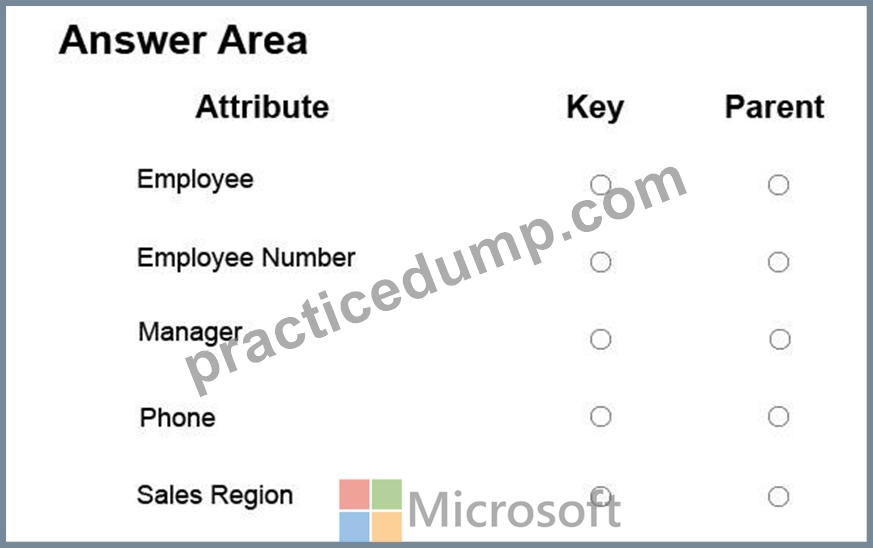
Answer:
Explanation:
Explanation:
The ManagerKey column, the Manager attribute, defines a foreign key constraint that references the EmployeeKey column, the Employee attribute.
NEW QUESTION 37
Note: This question is part of a series of questions that present the same scenario. Each question in the series contains a unique solution. Determine whether the solution meets the stated goals.
A company has an e-commerce website. When a customer places an order, information about the transaction is inserted into tables in a Microsoft SQL Server relational database named OLTP1. The company has a SQL Server Analysis Services (SSAS) instance that is configured to use Tabular mode. SSAS uses data from OLTP1 to populate a data model.
Sales analysts build reports based on the SSAS model. Reports must be able to access data as soon as it is available in the relational database.
You need to configure and deploy an Analysis Services project to the Analysis Services instance that allows near real-time data source access.
Solution: In the Deployment Option property for the report, you set the Query Mode to
InMemory.
Does the solution meet the goal?
- A. No
- B. Yes
Answer: A
Explanation:
With InMemory the queries can use the cache only.
References:https://msdn.microsoft.com/en-us/library/hh230898(v=sql.120).aspx
NEW QUESTION 38
Note: This question is part of a series of questions that use the same or similar answer choices. An answer choice may be correct for more than one question in the series. Each question is independent of the other questions in this series. Information and details provided in a question apply only to that question.
You administer a Microsoft SQL Server Analysis Services (SSAS) tabular model for a travel agency that specializes in vacation packages. Vacation bookings and packages are stored in a SQL Server database. You use the model as the basis for customer emails that highlight vacation packages that are currently underbooked, or projected to be underbooked.
The company plans to incorporate cruise ship vacation packages. Cruise ship vacation packages include new features such as region availability and cruise line specialties that require changes to the tabular model.
You must ensure that the tabular model reflects the new vacation packages.
You need to configure the tabular data model.
What should you do?
- A. Ensure that the Transactional Deployment property is set to True.
- B. Process the model in Process Data mode.
- C. Ensure that DirectQuery is disabled for the model.
- D. Ensure that the Transactional Deployment property is set to False.
- E. Process the model in Process Full mode.
- F. Ensure that DirectQuery is enabled for the model.
- G. Process the model in Process Defrag mode.
Answer: E
Explanation:
Process Full processes an Analysis Services object and all the objects that it contains.
When Process Full is executed against an object that has already been processed,
Analysis Services drops all data in the object, and then processes the object. This kind of processing is required when a structural change has been made to an object, for example, when an attribute hierarchy is added, deleted, or renamed.
NEW QUESTION 39
......
Authentic Best resources for 070-768 Online Practice Exam: https://www.practicedump.com/070-768_actualtests.html