

Pass Your Level 4 Diploma in Procurement and Supply L4M7 Exam Easily with Accurate PDF Questions [Dec 13, 2025]
L4M7 Certification Exam Dumps Questions in here
CIPS L4M7 certification exam consists of a series of modules that cover different aspects of asset management. These modules include strategic asset management, risk management, financial management, performance management, and sustainability. Each module is designed to provide candidates with a comprehensive understanding of the principles and practices of asset management, as well as the tools and techniques required to manage assets throughout their life cycle.
NEW QUESTION # 92
The ABC approach involves classifying inventory items by unit cost, with expensive items classi-fied as 'A' items and low cost items classified as 'C' items. Is this statement true?
- A. Yes, 'A' items represent approximately 20% of total unit prices
- B. Yes, 'C' items with the lowest unit prices are the tail spends
- C. No, ABC analysis considers the usage of each inventory item
- D. No, ABC analysis considers the supply risks associated with an inventory item
Answer: C
Explanation:
ABC analysis is an approach for classifying inventory items based on the items' consumption val-ues. Consumption value is the total value of an item consumed over a specified time period, for example a year. The approach is based on the Pareto principle to help manage what matters and is applied in this context:
- A items are goods where annual consumption value is the highest. Applying the Pareto principle (also referred to as the 80/20 rule where 80 percent of the output is determined by 20 percent of the input), they comprise a relatively small number of items but have a relatively high consumption value. So it's logical that analysis and control of this class is relatively intense, since there is the greatest potential to reduce costs or losses.
- B items are interclass items. Their consumption values are lower than A items but higher than C items. A key point of having this interclass group is to watch items close to A item and C item classes that would alter their stock management policies if they drift closer to class A or class C. Stock management is itself a cost. So there needs to be a balance between controls to protect the asset class and the value at risk of loss, or the cost of analysis and the potential value returned by reducing class costs. So, the scope of this class and the inventory management policies are determined by the estimated cost-benefit of class cost reduction, and loss control systems and processes.
- C items have the lowest consumption value. This class has a relatively high proportion of the total number of lines but with relatively low consumption values. Logically, it's not usually cost-effective to deploy tight inventory controls, as the value at risk of significant loss is relatively low and the cost of analysis would typically yield relatively low returns.
LO 2, AC 2.1
NEW QUESTION # 93
A supermarket calculates that the average holding cost for an item is $1.50 per cubic meter per day. A beer pallet which has volume of 0.5 cubic meter will be stored for 5 days. What is the holding cost of this beer pallet?
- A. $4.00
- B. $4.50
- C. $3.75
- D. $4.25
Answer: C
Explanation:
The holding cost per day of the beer pallet is equal to 1.50/2=0.75
The beer pallet is stored for 5 days, the total holding cost is: 0.75*5=3.75.
LO 2, AC 2.2
NEW QUESTION # 94
Which of the following costs does the EOQ minimise?
- A. Total cost of ordering inventory
- B. Total cost of safety stock
- C. Total cost of annual inventory cost
- D. Total cost of carrying stock
Answer: C
Explanation:
Economic order quantity (EOQ) was developed in 1913 by Ford W. Harris and has been refined over time.
The formula assumes that demand, ordering, and holding costs all remain constant. The EOQ minimizes the total annual inventory cost.
EOQ formula is as follow: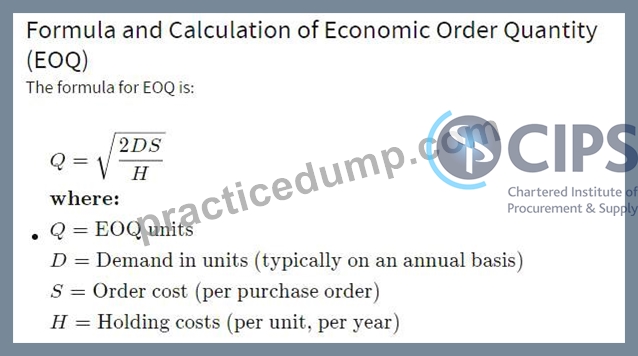
LO 2, AC 2.3
NEW QUESTION # 95
Which of the following are typical characteristics of 2D barcodes? Select TWO that apply.
- A. 2D barcodes can contain more data than 1D barcodes
- B. 2D barcodes can be read by linear scanners
- C. 2D barcodes are exclusively used for marketing purpose
- D. The 2D barcodes are machine-readable
- E. Every 2D barcodes must conform international standards
Answer: A,D
Explanation:
Two-dimensional (2D) barcodes look like squares or rectangles that contain many small, individual dots. This has many different types (i.e. Data matrix, QR codes, Aztec code,...) and several different standards in use (i.e. GS1 standards, ISO/IEC 18004:2015). It can be substituted for 1D barcode, but it has the capability to hold a larger amount of data. For examples, GS1 Data Matrix can contain 3116 Numeric characters or 2335 Alphanumeric characters while GS1-128 barcode has maximum capacity of 48 characters.
Like 1D barcodes, 2D barcodes are also machine-readable with dots/squares and spaces. They have symbology like this: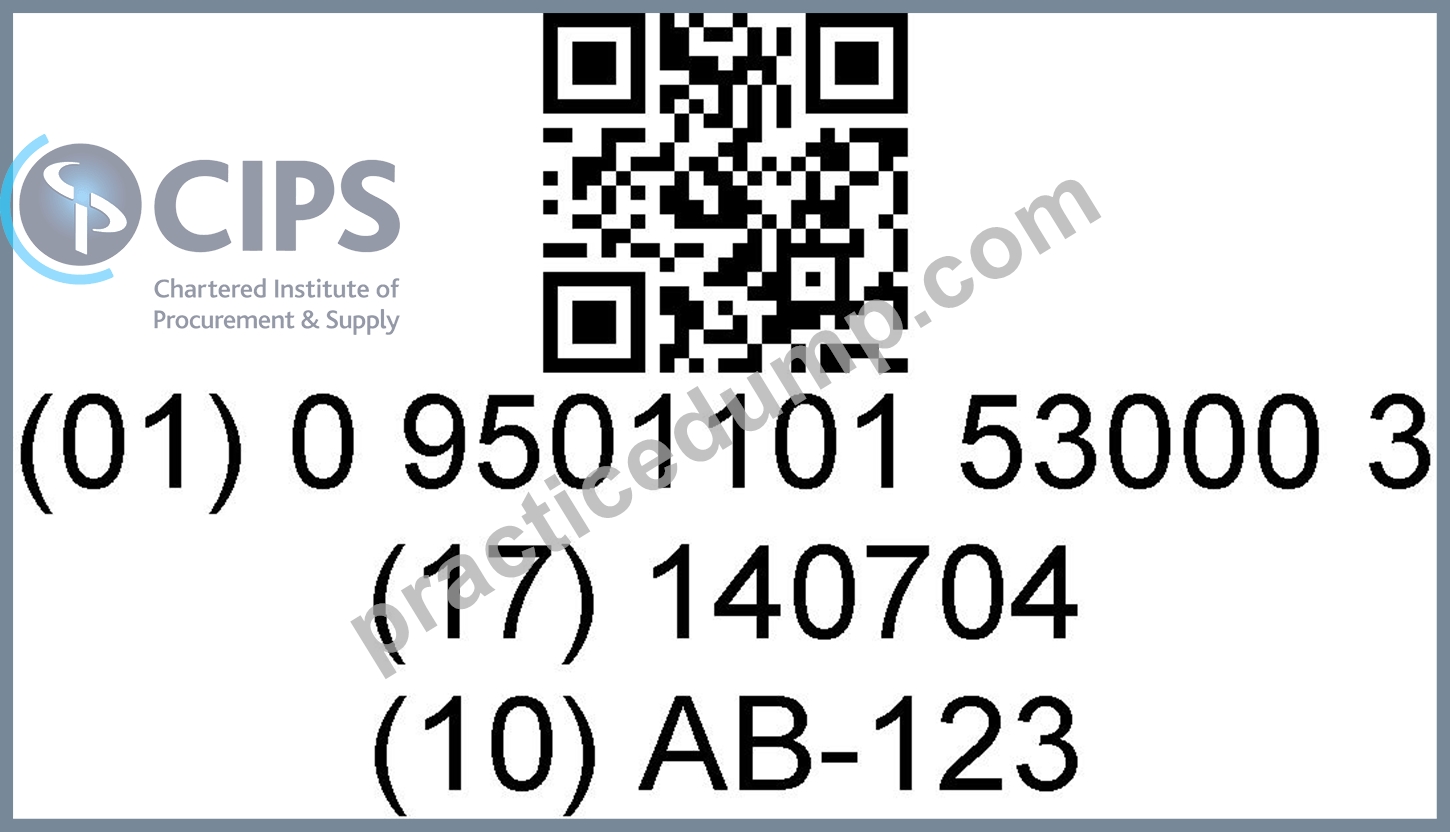
Since the code is two dimensional, conventional laser scanner can't read it. 2D barcodes require imaging scanner to read.
2D barcodes can be also used for different purposes throughout the supply chain: identifying prod-ucts/SKU (single unit, packaged or pallet), identifying content of a purchase order or delivery, identifying the batch number from which the item originates, identifying the manufacturer, country of origin etc, tracking status of an order, shipment or delivery Reference:
LO 1, AC 1.2
NEW QUESTION # 96
Which of the following lists all components, ingredients, and materials required to produce the final product?
- A. Master schedule
- B. Purchase order
- C. Engineering change notice
- D. Bill of materials
Answer: D
Explanation:
Master production schedule (MPS) plans items that have "direct" demand, or "independent de-mand." With independent demand, the demand comes from sales orders, service orders, or fore-casts, and the demand comes directly from customer-or forecasted-requirements. It is the list that provides the timing of the production schedule and shows how much each machine can produce, how many shifts are used, etc.
A bill of materials (BOM) is a comprehensive inventory of the raw materials, assemblies, subas-semblies, parts and components, as well as the quantities of each, needed to manufacture a product.
NEW QUESTION # 97
The purchase-order lead time is the...?
- A. Period between receiving a customer order and delivering the items
- B. Period between receiving a customer order and producing the products
- C. Time needed to correct errors in the defective products
- D. Period between placing an order and its delivery
Answer: D
Explanation:
Purchase order lead time (POLT) refers to the number of days from when a company places an order for production inputs it needs, to when those items arrive at the manufacturing plant.
LO 2, AC 2.3
NEW QUESTION # 98
Which of the following best defines 'exponential moving average'?
- A. A process by which a decision is taken at a period end or review point to determine how much to reorder
- B. A process by which the reorder of an item is triggered by the inventory level dropping to a predetermined level
- C. A forecasting technique where the average is calculated by dividing the sum of the val-ues by the number of values
- D. A forecasting technique where each demand is multiplied by a weighting factor
Answer: D
Explanation:
An exponential moving average (EMA) is a type of moving average (MA) that places a greater weight and significance on the most recent data points. The exponential moving average is also referred to as the exponentially weighted moving average. An exponentially weighted moving average reacts more significantly to recent price changes than a simple moving average (SMA), which applies an equal weight to all observations in the period.
Reference:
LO 2, AC 2.3
NEW QUESTION # 99
A group of items which are stacked together for more convenient movement is called...?
- A. Load cell
- B. Unit price
- C. Unit load
- D. Stacker
Answer: C
Explanation:
Unit load is a term used to describe grouping of different items into a convenient stack or stacks which make them easy to handle and store. Typically this involves pallets and/or the plastic wrap-ping of a load.
Stacker is designed to lift and stack pallets. This one is fully mobile so can move easily around the warehouse.
An operator would typically sit or stand while driving like a counterbalanced, reach or straddle lift truck.
A load cell is a type of transducer, specifically a force transducer. It converts a force such as ten-sion, compression, pressure, or torque into an electrical signal that can be measured and standard-ized.
Unit price is the price of a single product or service, used for example when buying several things together to refer to the price of each one.
NEW QUESTION # 100
Extra units that are held in inventory to reduce the risks of stock-out are called...?
- A. Safety stock
- B. Demand variance
- C. Just-in-time
- D. Reorder point
Answer: A
Explanation:
The safety stock (or buffer stock) is the stock level that limits stock shortages due to unforeseen events (forecasts not in line with demand, longer than expected supply time, etc...) Demand variance is the degree to which the demand in a fixed period deviates from the average demand of the same period.
A reorder point is the unit quantity on hand that triggers the purchase of a predetermined amount of replenishment inventory.
The just-in-time (JIT) inventory system is a management strategy that aligns raw-material orders from suppliers directly with production schedules.
NEW QUESTION # 101
Which of the following are warehouse layouts that allow the cross aisle to meet picking aisle at angles different from 90 degrees?
1. 'Fan' shaped layout
2. Herringbone-shaped layout
3. U-shape layout
4. L-shape layout
- A. 1 and 3 only
- B. 3 and 4 only
- C. 1 and 2 only
- D. 2 and 3 only
Answer: C
Explanation:
In a traditional warehouse, storage racks are arranged to create parallel picking aisles, perhaps with one or more cross aisles to allow workers to move quickly between picking aisles. This structure forces workers to travel rectilinear distances (north-south and east-west) to picking locations.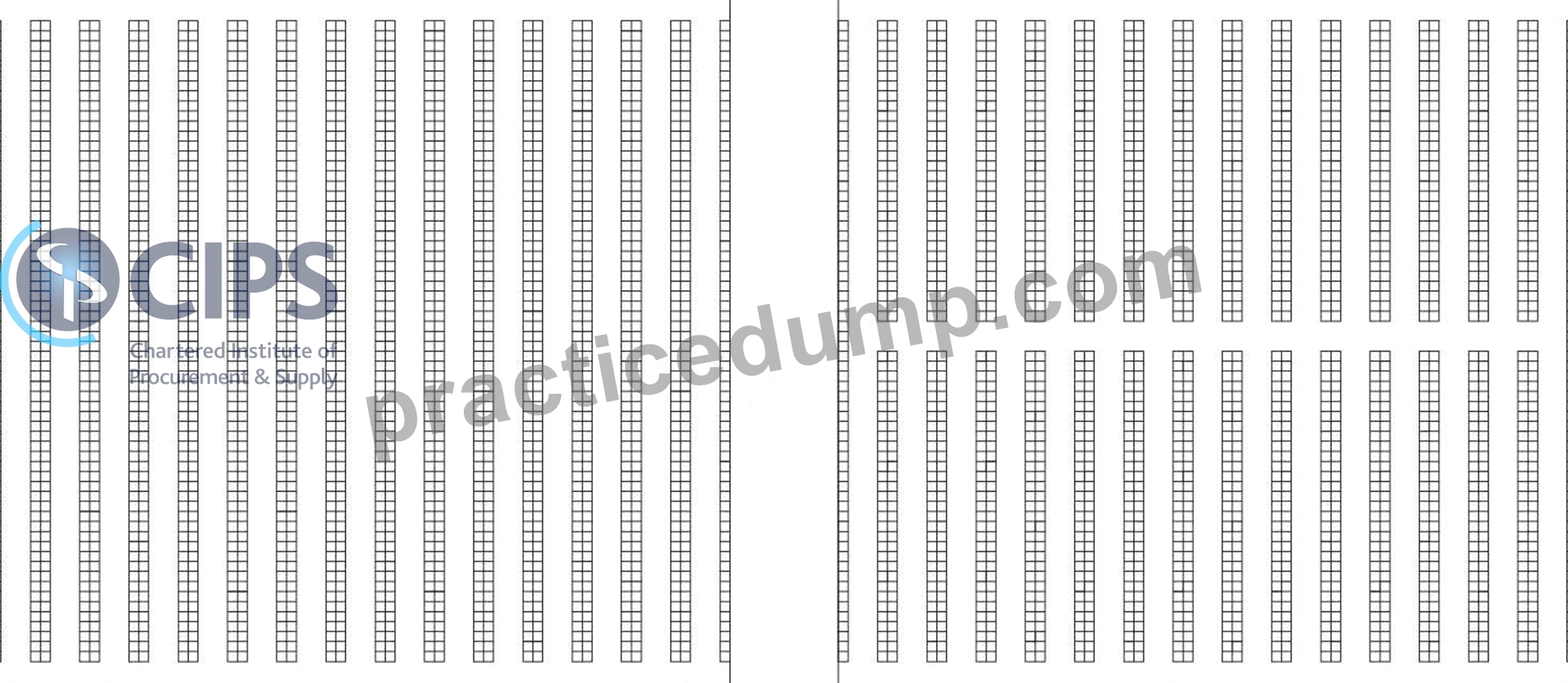
Kevin R. Gue and Russell D. Meller proposed alternative aisle designs:
- The 'Fan' shaped layout (or "Flying V"). This layout maintains parallel picking aisles, but al-lows the cross aisle to take on a different shape. If travel begins and ends at the bottom of the V, Gue and Meller expected distance to retrieve a single pallet is 10% less in this warehouse than in an equivalent traditional design.
- The Herringbone-shaped layout (or commonly referred as Fishbone layout) combines the verti-cal picking rows of a traditional warehouse with a second set of horizontal picking rows, divided by a V-shaped diagonal alley crossing the entire warehouse. This simple modification to the typical warehouse design allows employees (e.g. a forklift driver) to increase travel speed between picking locations. Efficiency gains achieved through a layout reconfiguration would reduce picking cost up to 23% compared to an equivalent warehouse using a traditional configuration.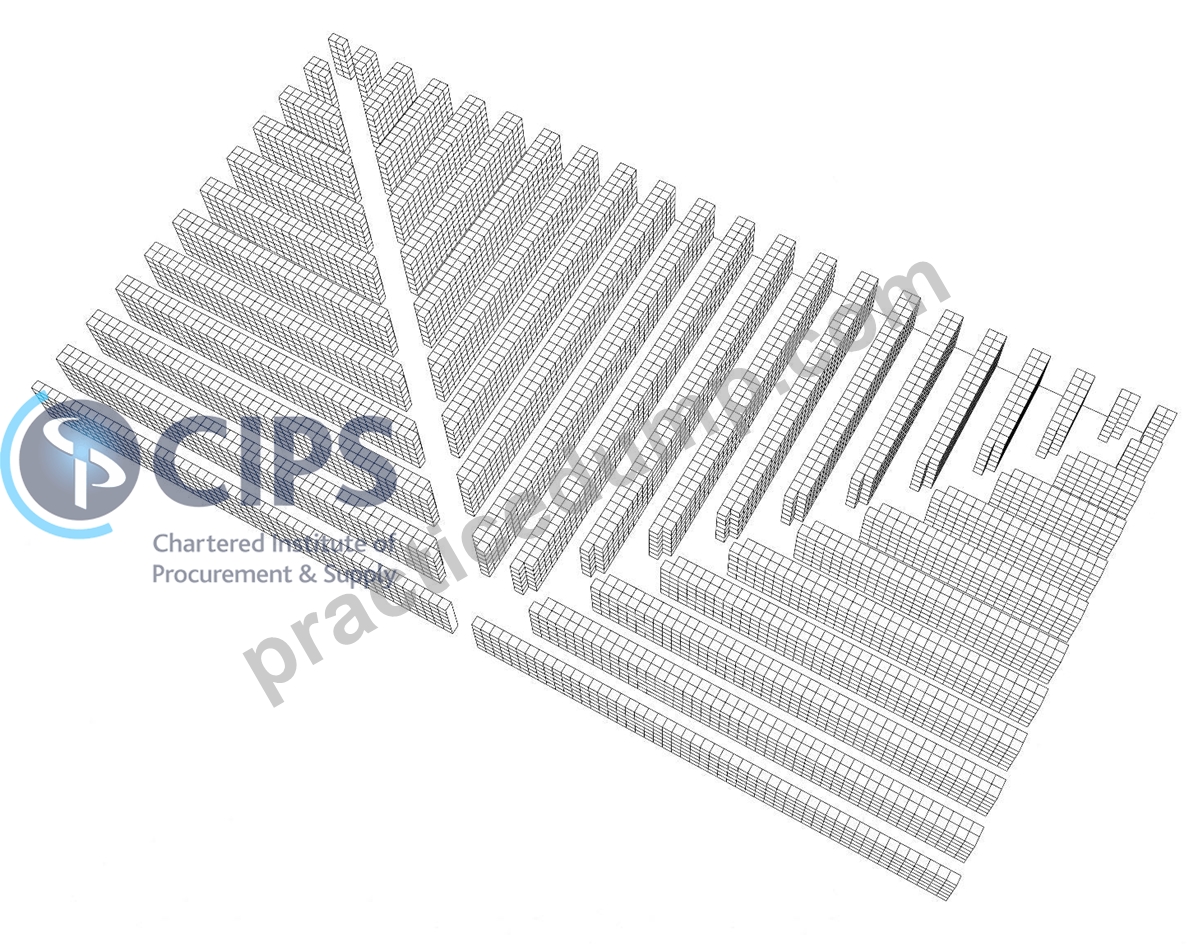
Reference
Aisle Design - Kevin Gue
LO 1, AC 1.1
NEW QUESTION # 102
RFID, or Radio Frequency Identification, is fast emerging as a major commercial technology. Like every new technology, it has advantages and disadvantages. An advantage of using RFID is that...
- A. Tags only store limited data, whereas a barcode can hold unlimited data
- B. It is better than barcodes as it cannot be easily replicated, and therefore, increases the security on a product
- C. It is easy to implement and requires little investment in information technology
- D. It is cheaper for many applications compared to other tracking and identification methods
Answer: B
NEW QUESTION # 103
Which of the following are advantages of a multi-story warehouse compared to a single-story warehouse?
* Heavier, frequently moved items will always be stored on the upper floor of a multi-story warehouse
* Order tracking technology is more effective and efficient in a multi-story warehouse
* There are more options for the storage of inventory by volume, weight, and frequency of movement in a multi-story warehouse
* The cost of land is likely to be less for a multi-story warehouse compared to a single-story warehouse for a similar product volume
- A. 1 and 2 only
- B. 3 and 4 only
- C. 2 and 3 only
- D. 1 and 4 only
Answer: B
NEW QUESTION # 104
A logistics company has a 2-story warehouse in the suburban area. The goods receiving area and dispatch area are located on the ground floor only. There is a lift connecting the two floors. The daily operations of the warehouse are quite busy. Which of the following would the best arrangement for this warehouse?
- A. Small items in tote boxes will be stored on the ground floor with forklifts and other equipment, high- usage palletised items will be stored on the first floor
- B. Medium- to low-usage palletised items will be stored on the ground floor, high-usage items will be stored on the first floor where the building administrative office is located
- C. Pallets, roller cages and other bulky items will be stored on the ground floor, smaller items in plastic tote boxes will be stored on the first floor
- D. Forklifts and other warehouse equipment will park on the ground floor, all inventories will be stored on the first floor
Answer: C
Explanation:
The purposes of a warehouse are to keep the inventories in good condition and to ensure that the operations is smooth. In the scenario, the warehouse has 2 stories, with goods-in and goods-out areas located on the ground floor and a lift connecting the stories. The lift could become a bottleneck if the goods inside the warehouse are not well-arranged.
Since the lift is often small with limited load capacity, putting heavy bulk items on the first floor will cause bottleneck and increase the chance of accidents. Therefore, palletised items (even they have low-usage) should be placed on the ground floor. Smaller and lighter items should be stored on the first floor.
This question does appear in the real exam. To answer the question, students should imagine the situation.
NEW QUESTION # 105
What is the stock turn for a store holding products to the value of £250,000 with annual sales of these products amounting to £1,000,000?
- A. 0.4
- B. 0
- C. 1
- D. 0.25
Answer: C
Explanation:
Calculating Inventory Turnover (Stock Turn)
As with a typical turnover ratio, inventory turnover details how much inventory is sold over a period. To calculate the inventory turnover ratio, cost of goods (COGS) is divided by the average inventory for the same period.1 Cost of Goods Sold ÷ Average Inventory or Sales ÷ Inventory In this exercise, the stock turn equal to sales divided by inventory, or 1,000,000:250,000 = 4.
Reference:
LO 2, AC 2.3
NEW QUESTION # 106
Which of the following should be considered when an organisation plans for disposing obsolescent and redundant stock? Select TWO that apply.
- A. Environmental issues
- B. ABC analysis
- C. Financial costs
- D. Economic order quantity
- E. Takt time
Answer: A,C
Explanation:
If the planning and mitigation measures fail and redundant or obsolete stock is identified, it needs to be removed from the current inventory location as quickly as possible. There are some methods to dealwith these types of stock. The worst case scenario is disposal to landfill, which is inadvisable if it can be avoided, both from environment point of view and the financial costs of such disposal.
For example, the problem of obsolete pesticides remains extremely serious and urgent. Many of the stocks identified continue to deteriorate thereby giving rise to an ever escalating source of severe pollution and posing a threat to human health, the environment and development in particular. To reduce the impact of obsolete pesticides on environment, FAO initiated a project in Yemen in which a total of 262 tonnes of obsolete pesticides were removed from 20 different sites and successfully disposed of between March and June 1996. The major field operation was completed in six weeks during which period almost all obsolete pesticides were brought to a central location and subsequently shipped to the United Kingdom for incineration.
NEW QUESTION # 107
Multiple approval levels for a small purchase request is an example of which type of waste?
- A. Inventory
- B. Over-production
- C. Not using talent
- D. Over-processing
Answer: D
Explanation:
Lean thinking aims to remove wastes from work processes. Before diving into the 8 wastes, it is important to understand what waste is. Waste is any action or step in a process that does not add value to the customer. In other words, waste is any process that the customer does not want to pay for.
The original seven wastes (Muda) was developed by Taiichi Ohno, the Chief Engineer at Toyota, as part of the Toyota Production System (TPS). The seven wastes are Transportation, Inventory, Motion, Waiting, Overproduction, Overprocessing and Defects. They are often referred to by the acronym 'TIMWOOD'. The
8th waste of non-utilized talent or 'Skills' of workers was later introduced in the 1990s when the Toyota Production System was adopted in the Western world. As a result, the 8 wastes are commonly referred to as
'TIMWOODS'.
A picture containing application Description automatically generated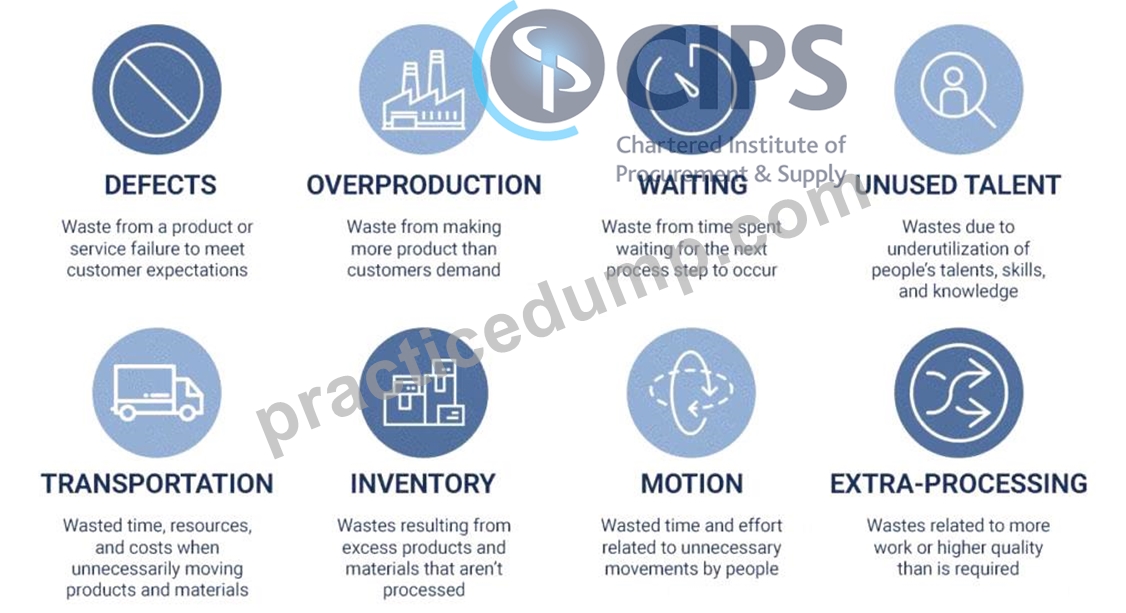
Source: The lean way
Multiple approval levels for a small purchase request is an example of over-processing since this adds more unnecessary work to users and procurement professionals.
NEW QUESTION # 108
Ranger Mobile Ltd is a emerging smartphone manufacturer. The manufacturer adopts the just-in-time method:
First, the customers make orders, then it will decide which components to be pur-chased according to the bill of materials. These components are known as which of the following?
- A. Indirect items
- B. Capital goods
- C. Dependent demand items
- D. Independent forecast items
Answer: C
Explanation:
Dependent demand is the requirement for stock item which is directly related to and therefore de-pendent upon the rate of production (examples are: raw materials, components, energy). The com-ponents in the scenario are dependent demand items.
Independent demand is the requirement for stock item which is not directly related to, and is therefore independent of rate of production.
NEW QUESTION # 109
......
CIPS L4M7 Exam is a comprehensive certification program that covers all aspects of asset management, from design and construction to operation and disposal. The program is designed to equip professionals with the knowledge and skills they need to manage assets effectively and efficiently throughout their lifecycle. The program is delivered through a combination of online learning, self-study, and classroom training, ensuring that participants have the flexibility to learn at their own pace. Upon completion of the program, participants will have gained a thorough understanding of asset management practices and will be able to apply these practices in their workplace. The CIPS L4M7 Exam is recognized globally and is highly respected by employers, making it an excellent choice for professionals who want to enhance their career prospects in the asset management field.
Verified L4M7 dumps Q&As 100% Pass in First Attempt Guaranteed Updated Dump: https://drive.google.com/open?id=19Z9in9uuA85DFnitcKzzzhlZJF-VKhh5
Updated L4M7 Exam Practice Test Questions: https://www.practicedump.com/L4M7_actualtests.html