

Real Juniper JN0-336 Exam Dumps with Correct 68 Questions and Answers
Valid JN0-336 Test Answers & Juniper JN0-336 Exam PDF
NEW QUESTION # 32
Which rule base in an IDP policy is used to eliminate false positives?
- A. monitor
- B. exempt
- C. signature
- D. IPS
Answer: B
Explanation:
The correct answer is D. exempt. In Junos IDP, the exempt rulebase is specifically used to prevent selected traffic from triggering known false-positive detections. Juniper's IDP documentation explains that exempt rules can be configured when an IDP policy generates false positives for a particular attack object, source, destination, or traffic pattern. The exempt rulebase lets the administrator exclude matching traffic from attack detection while still allowing the rest of the IDP policy to inspect other traffic normally.
Option A, IPS, is wrong because the IPS rulebase is the main inspection rulebase used to detect and act on attacks. It is where attack objects and actions are commonly applied, but it is not the rulebase designed to eliminate false positives. Option B, monitor, is not the correct false-positive elimination mechanism.
Monitoring can help observe behavior, but it does not exempt traffic from matching an attack object. Option C, signature, is wrong because signatures are attack-detection patterns, not a rulebase type used to suppress false positives. The operational correction for noisy or irrelevant matches is to create an exempt rule for the specific trusted source, destination, or attack object. Reference topics: IDP rulebases, exempt rulebase, false- positive tuning, attack objects, IPS inspection.
NEW QUESTION # 33
When a security policy is modified, which statement is correct about the default behavior for active sessions allowed by that policy?
- A. Only policy changes that involve modification of the action field will cause the active sessions affected by the change to be dropped.
- B. The active sessions allowed by the policy will continue unchanged.
- C. The active sessions allowed by the policy will be dropped.
- D. Only policy changes that involve modification of the application will cause the active sessions affected by the change to be dropped.
Answer: B
Explanation:
When you modify a security policy on the SRX Series device, the default behavior is that the existing sessions that match the policy will continue unchanged. This means that the policy modification will only affect new sessions that are initiated after the change. However, you can change this behavior by using the clear-policy-session command, which will clear all the sessions that match the modified policy and force them to re-evaluate the new policy. Reference: = JNCIS-SEC Certification, Open Learning - Security, Specialist (JNCIS-SEC), Security Policies (Advanced)
NEW QUESTION # 34
Which two statements are correct about cluster components? (Choose two.)
- A. Cluster ID values range from 1 through 255.
- B. Node ID values are either 0 or 1.
- C. Cluster ID values are either 0 or 1.
- D. Node ID values range from 1 through 255.
Answer: A,B
Explanation:
The correct answers are A and B. In an SRX chassis cluster, the cluster ID identifies the chassis cluster itself, while the node ID identifies the individual SRX device inside that two-node cluster. Juniper states that a cluster is identified by a cluster-id value from 1 through 255, and that setting the cluster ID to 0 is equivalent to disabling clustering. Therefore, option A is correct and option C is wrong.
Option B is also correct because Juniper states that a cluster node is identified by a node ID specified as a number from 0 through 1. A normal SRX chassis cluster has two nodes: node0 and node1. The two devices must use the same nonzero cluster ID so they belong to the same cluster, but each device must use a different node ID so Junos can apply node-specific configuration, interface numbering, redundancy-group ownership, and management settings correctly. Option D is wrong because node IDs do not range from 1 through 255; that range applies to cluster IDs, not node IDs. Reference topics: HA Clustering, cluster ID, node ID, chassis cluster formation, node0/node1 identification.
NEW QUESTION # 35
Which two statements are true about the vSRX? (Choose two.)
- A. Linux is the base OS.
- B. It has VMXNET3 vNIC support.
- C. UNIX is the base OS.
- D. It does not have VMXNET3 vNIC support.
Answer: A,B
Explanation:
Reference: Juniper Networks Security, Specialist (JNCIS-SEC) Study Guide, Chapter 1: Introduction to Junos Security, page 1-8.
The vSRX is a virtual security appliance that runs on a virtual machine. It provides firewall, VPN, and other security services in a virtualized environment.
The vSRX is based on a version of Junos OS that is optimized for virtualization. It runs on a Linux kernel and uses a KVM hypervisor. It supports VMware ESXi and KVM hypervisors.
The vSRX has support for VMXNET3 vNICs, which are high-performance virtual network interfaces provided by VMware. These interfaces can provide higher throughput and lower CPU utilization than other virtual NIC types.
NEW QUESTION # 36
Which statement defines the function of an Application Layer Gateway (ALG)?
- A. The ALG contains protocols that use one application session for each TCP session.
- B. The ALG uses software processes for permitting or disallowing specific IP address ranges.
- C. The ALG uses software that is used by a single TCP session using the same port numbers as the application.
- D. The ALG uses software processes for managing specific protocols.
Answer: D
Explanation:
The statement that defines the function of an Application Layer Gateway (ALG) is: The ALG uses software processes for managing specific protocols. An ALG is a security component that operates at the application layer (layer 7) of the OSI model and handles data associated with certain application protocols, such as SIP, FTP, RTSP, etc. An ALG acts as a proxy or intermediary between the client and the server applications and performs various functions, such as address and port translation, resource allocation, application response control, and synchronization of data and control traffic. An ALG can also inspect and modify the application payload to enable firewall or NAT traversal, prevent spoofing or DoS attacks, or enforce granular security policies based on application-specific commands. Reference: = Application-level gateway - Wikipedia, What Is an Application Layer Gateway (ALG)? | F5, What is ALG
** Application Layer Gateway | 3CX
NEW QUESTION # 37
You need to set up a forward proxy on your SRX Series device.
In this scenario, which two statements are correct? (Choose two.)
- A. The forward proxy uses the managed SRX as a trusted certificate authority (CA).
- B. The forward proxy forwards the server certificate.
- C. The forward proxy uses Encrypted Traffic Insights to monitor traffic.
- D. The forward proxy looks like a client to the servers to which it communicates.
Answer: A,D
Explanation:
The correct answers are A and C. In SSL forward proxy, the SRX sits between internal clients and external SSL/TLS servers. Juniper's SSL proxy configuration documentation shows that a forward proxy profile is created when root-ca is configured and server-certificate is not configured. This root CA is used by the SRX to generate substitute certificates for intercepted SSL sessions, so internal clients must trust the CA used by the firewall. Juniper's procedure specifically includes generating or loading a local certificate and applying it as the root-ca in the SSL proxy profile.
Option C is also correct because forward proxy terminates the client-side SSL session and establishes a separate SSL session toward the destination server. Juniper states that the SSL proxy acts as an SSL server to the client and establishes a new SSL session to the server; from the server's perspective, the SRX is the SSL client. Option B is wrong because forward proxy intercepts the server certificate and creates a substitute certificate; forwarding the actual server certificate unchanged is associated with reverse proxy behavior.
Option D is wrong because Encrypted Traffic Insights is not the required forward-proxy mechanism here.
Reference topics: SSL Proxy, SSL forward proxy, root CA, client protection, certificate interception.
NEW QUESTION # 38
Which solution enables you to create security policies that include user and group information?
- A. JIMS
- B. Network Director
- C. ATP Appliance
- D. NETCONF
Answer: A
Explanation:
The solution that enables you to create security policies that include user and group information is JIMS (Juniper Identity Management Service). JIMS collects and maintains a large database of user, device, and group information from Active Directory domains or syslog sources, and enables SRX Series devices to rapidly identify thousands of users in a large, distributed enterprise. With JIMS, you can create security policies that include user and group information, and enforce user-based access control policies to protect network resources.
NEW QUESTION # 39
What are two causes that end the processing of rules in IDP? (Choose two.)
- A. when a rule is matched in the rule base with an action of close
- B. when a rule is matched in the rule base with an action of ignore
- C. when a terminal rule is matched in the rule base
- D. when any rule is matched in the exempt rule base
Answer: B,C
Explanation:
The correct answers are B and D. A terminal rule is specifically designed to stop further rule evaluation.
Juniper states that the IDP rule-matching algorithm normally checks traffic against all matching rules in the rulebase, but when a terminal rule matches the source, destination, zones, and application, IDP does not continue to check subsequent rules for that same traffic. Juniper also warns that traffic matching a terminal rule is not compared to later rules even if it does not match the attack object inside that terminal rule.
Option D is also correct because the Ignore Connection action stops scanning traffic for the rest of the connection if an attack match is found. Juniper defines Ignore Connection as disabling the rulebase for that specific connection after a match. Option A is wrong because a close action closes the connection by sending reset behavior, but it is not the rule-processing control mechanism being tested. Option C is a trap: the exempt rulebase is used to suppress known false positives after an IPS rule match, but the two direct mechanisms that end IDP rule processing are terminal rule matching and ignore connection. Reference topics: IDP rulebases, terminal rules, Ignore Connection action, rule-matching algorithm, false-positive exemption.
NEW QUESTION # 40
Which two statements are correct about IDP policy templates? (Choose two.)
- A. They are available on a "factory-default config."
- B. They must be installed.
- C. They are not customizable.
- D. They are provided by Juniper Networks.
Answer: B,D
Explanation:
The correct answers are A and D. Juniper provides predefined IDP policy templates to simplify IDP deployment. These templates are supplied by Juniper Networks and include common templates such as client protection, server protection, DMZ services, DNS server, file server, web server, IDP default, and recommended policies. Juniper's IDP documentation states that predefined templates are available from a secured Juniper Networks website, and the listed templates are explicitly described as being provided by Juniper Networks.
Option D is correct because these templates are not automatically present as usable policies in a factory- default SRX configuration. Juniper's procedure says that to use predefined IDP policy templates, you download the policy templates and then install them. The CLI process includes request security idp security- package download policy-templates followed by request security idp security-package install policy- templates; committing then makes them available under the IDP policy hierarchy.
Option B is wrong because Juniper specifically says you should customize these templates for your network and recommends using a copied template so you can safely make changes. Option C is wrong because they must be downloaded and installed, so they are not simply available in the factory-default configuration.
Reference topics: IDP, predefined IDP policy templates, security-package download, security-package install, active IDP policy.
NEW QUESTION # 41
You want to use IPS signatures to monitor traffic.
Which module in the AppSecure suite will help in this task?
- A. AppQoS
- B. AppFW
- C. AppTrack
- D. APPID
Answer: B
Explanation:
The AppFW module in the AppSecure suite provides IPS signatures that can be used to monitor traffic and detect malicious activities. AppFW also provides other security controls such as Web application firewall, URL filtering, and application-level visibility.
NEW QUESTION # 42
Which two functions does Juniper ATP Cloud perform to reduce delays in the inspection of files? (Choose two.)
- A. Juniper ATP Cloud uses a single antivirus software package to analyze files.
- B. Juniper ATP Cloud performs a cache lookup on files.
- C. Juniper ATP Cloud allows end users to bypass the inspection of files.
- D. Juniper ATP Cloud allows the creation of allowlists.
Answer: B,D
Explanation:
The correct answers are A and D. Juniper ATP Cloud reduces inspection delay in two practical ways: trusted allowlists and cache lookup. An allowlist contains known trusted IP addresses, hashes, email addresses, and URLs; Juniper states that content downloaded from locations on the allowlist does not have to be inspected for malware. That eliminates unnecessary cloud-analysis cycles for known trusted sources or objects.
Option D is also correct because ATP Cloud performs a real-time cache lookup before deeper analysis.
Juniper explains that when a file is uploaded, ATP Cloud first checks whether the file has been analyzed before; if it has, the stored verdict is returned to the SRX Series Firewall and there is no need to re-analyze the file. This directly reduces inspection delay and enables faster enforcement. Option B is wrong because ATP Cloud does not rely on a single antivirus engine; it uses a pipeline that can include cache lookup, antivirus, static analysis, dynamic analysis, and machine learning. Option C is wrong because inspection bypass is not delegated to end users. Reference topics: ATP Cloud, allowlists, file inspection workflow, cache lookup, malware analysis pipeline.
NEW QUESTION # 43
Referring to the exhibit, what should you do to ensure that Juniper ATP Cloud detects malware in HTTPS traffic?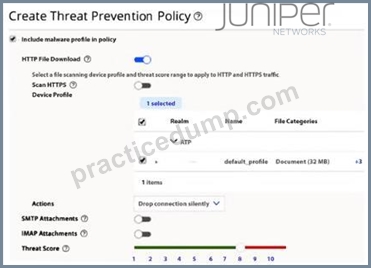
- A. Manually configure and apply an SSL proxy profile.
- B. Configure a new device profile that includes encrypted traffic.
- C. Change the action to redirect the encrypted traffic to a decryption device.
- D. Lower the threat score.
Answer: A
Explanation:
The correct answer is A. Manually configure and apply an SSL proxy profile. HTTPS traffic is encrypted, so ATP Cloud cannot extract and submit downloaded files for malware analysis unless the SRX can decrypt the SSL/TLS session first. Juniper's ATP Cloud documentation states that to detect malware in HTTPS traffic, you must configure the SSL inspection CA used for SSL forward proxy, and the ATP Cloud policy workflow specifically includes configuring an SSL proxy profile to inspect HTTPS traffic. Juniper's example shows the SSL proxy profile being created with a root CA and then applied so HTTPS sessions can be inspected before advanced anti-malware processing occurs.
Option B is wrong because lowering the threat score only changes the enforcement threshold after a file verdict is returned; it does not solve the inability to inspect encrypted payloads. Option C is wrong because changing the ATP device profile alone does not decrypt HTTPS traffic. The exhibit already shows a malware profile and HTTP file-download configuration, but HTTPS malware detection still requires SSL proxy.
Option D is wrong because Junos ATP Cloud integration does not require redirecting encrypted traffic to a separate decryption appliance for this task. The SRX performs SSL forward proxy locally, then advanced anti- malware can inspect extracted content. Reference topics: ATP Cloud, HTTPS malware inspection, SSL forward proxy, SSL inspection CA, advanced anti-malware policy.
NEW QUESTION # 44
Which method does the loT Security feature use to identify traffic sourced from IoT devices?
- A. The SRX Series device streams transit traffic received from the IoT device to Juniper ATP Cloud.
- B. The SRX Series device streams metadata from the loT device transit traffic to Juniper ATP Cloud Juniper ATP Cloud.
- C. The SRX Series device identifies loT devices from metadata extracted from their transit traffic.
- D. The SRX Series device identifies loT devices using their MAC address.
Answer: C
Explanation:
The metadata is used to identify the type of device, its associated activities and its threat profile. This information is used to determine the appropriate security policy for the device. For more information on loT Security, please refer to the Juniper Security, Specialist (JNCIS-SEC) study guide.
NEW QUESTION # 45
Click the Exhibit button.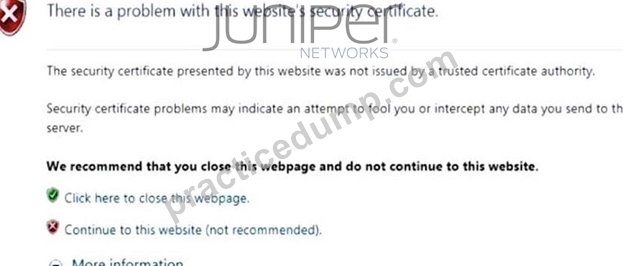
You have implemented SSL client protection proxy. Employees are receiving the error shown in the exhibit.
How do you solve this problem?
- A. Install a new SRX Series device to act as the client proxy
- B. Import the existing certificate to each client device.
- C. Load a known good, but expired. CA certificate onto the SRX Series device.
- D. Reboot the SRX Series device.
Answer: B
Explanation:
SSL client protection proxy is a feature that allows you to decrypt and inspect the SSL traffic from clients to servers. To do this, you need to install a certificate authority (CA) certificate on the SRX Series device and import the same certificate to each client device. This way, the SRX Series device can act as a proxy between the client and the server and perform security checks on the decrypted traffic. If the client device does not have the certificate installed, it will receive an error message like the one shown in the exhibit. Reference: = JNCIS-SEC Certification, Open Learning - Security, Specialist (JNCIS-SEC), SSL Proxy Configuration
NEW QUESTION # 46
You enable chassis clustering on two devices and assign a cluster ID and a node ID to each device.
In this scenario, what is the correct order for rebooting the devices?
- A. Reboot the secondary device, then the primary device.
- B. Reboot only the primary device since the secondary will assign itself the correct cluster and node ID.
- C. Reboot the primary device, then the secondary device.
- D. Reboot only the secondary device since the primary will assign itself the correct cluster and node ID.
Answer: A
Explanation:
When chassis clustering is enabled and IDs are assigned, it is typically recommended to first reboot the secondary device. This allows the secondary device to fully integrate and recognize its role and settings within the cluster without affecting the ongoing traffic that the primary device might be handling.
Once the secondary device has successfully rebooted and is operational within the cluster, the primary device can then be rebooted. This ensures that the primary device's reboot does not cause any network downtime, as the secondary device, now fully operational, can take over the traffic and roles as needed.
NEW QUESTION # 47
Which two statements are correct about the cSRX? (Choose two.)
- A. The cSRX supports firewall, NAT, IPS, and UTM services.
- B. The cSRX has three default zones: trust, untrust, and management
- C. The cSRX supports BGP, OSPF. and IS-IS routing services.
- D. The cSRX only supports Layer 2 "bump-in-the-wire" deployments.
Answer: A,B
Explanation:
The two statements that are correct about the cSRX are that it supports firewall, NAT, IPS, and UTM services, and that it has three default zones: trust, untrust, and management. The cSRX is a software- defined security solution that provides comprehensive network security capabilities and is designed for virtualized environments. It supports firewall, NAT, IPS, and UTM services to protect against threats, as well as BGP, OSPF, and IS-IS routing services for routing functionality. Additionally, the cSRX has three default zones: trust, untrust, and management. The trust zone is used to define traffic that is allowed to enter the network, the untrust zone is used to define traffic that should be blocked from entering the network, and the management zone is used to manage the device itself. The cSRX does not support Layer 2 "bump-in-the-wire" deployments.
NEW QUESTION # 48
You are asked to block malicious applications regardless of the port number being used.
In this scenario, which two application security features should be used? (Choose two.)
- A. AppFW
- B. AppTrack
- C. AppQoE
- D. APPID
Answer: A,D
NEW QUESTION # 49
Which two statements are correct about redundant fabric interfaces in a chassis cluster? (Choose two.)
- A. fab0 is located on node0, whereas fab1 is located on node1.
- B. fab0 and fab1 are located on both node0 and node1.
- C. The media type must be the same for each redundant fabric interface.
- D. The media type can be different for each redundant fabric interface.
Answer: A,C
Explanation:
The correct answers are B and C. In an SRX chassis cluster, the fabric connection is represented by two logical fabric interfaces: fab0 and fab1. Juniper configuration examples show fab0 assigned to the node0-side fabric member interface and fab1 assigned to the node1-side fabric member interface; for example, Juniper shows fab0 using a node0 interface such as ge-0/0/1 and fab1 using a node1 interface such as ge-7/0/1. That eliminates option A, because fab0 and fab1 are not both independently located on both nodes; they represent the two node sides of the cluster fabric link.
Option C is also correct. Juniper states that only the same type of interfaces can be configured as fabric children, and for dual fabric links both child interface types should match, such as Gigabit Ethernet with Gigabit Ethernet or 10-Gigabit Ethernet with 10-Gigabit Ethernet. Option D is therefore wrong because mixed media types are not supported for the redundant fabric child interfaces. Reference topics: HA Clustering, chassis cluster fabric interfaces, fab0/fab1, redundant fabric links, fabric child interface requirements.
NEW QUESTION # 50
After JSA receives external events and flows, which two steps occur? (Choose two.)
- A. After the information is filtered, JSA responds with active measures
- B. After formatting the data, the data is stored in an asset database.
- C. Before the information is filtered, the information is formatted
- D. Before formatting the data, the data is analyzed for relevant information.
Answer: B,C
Explanation:
When JSA (Juniper Secure Analytics) receives external events and flows, the typical processing steps are:
Option C. Before the information is filtered, the information is formatted.
Data formatting is an initial step in the process where raw data from events and flows is converted into a standard format that can be more easily processed and analyzed by JSA.
Option A. After formatting the data, the data is stored in an asset database.
Once the data is formatted, it is stored in an asset database. This database acts as a repository for all the formatted data, enabling JSA to perform further analysis, correlation, and eventually, to maintain a comprehensive view of the network assets and activities.
These steps are part of JSA's comprehensive approach to security event management, which involves collecting, normalizing, and analyzing data to identify potential security threats and vulnerabilities efficiently.
NEW QUESTION # 51
You set up the Juniper ATP Appliance solution on your network and notice that the macOS files are not being analyzed......... malware.
In this scenario, what must you do?
- A. Under Config > System Profiles≥Secondary Cores workspace, enable macOs Detection.
- B. You must obtain a Apple Mac Mini device and install the secondary core software.
- C. Under Config -> System Profiles→≥Secondary Cores workspace, create a macOS profile
- D. Create a macOS virtual machine on the JATP Appliance and install the secondary core software.
Answer: C
NEW QUESTION # 52
Exhibit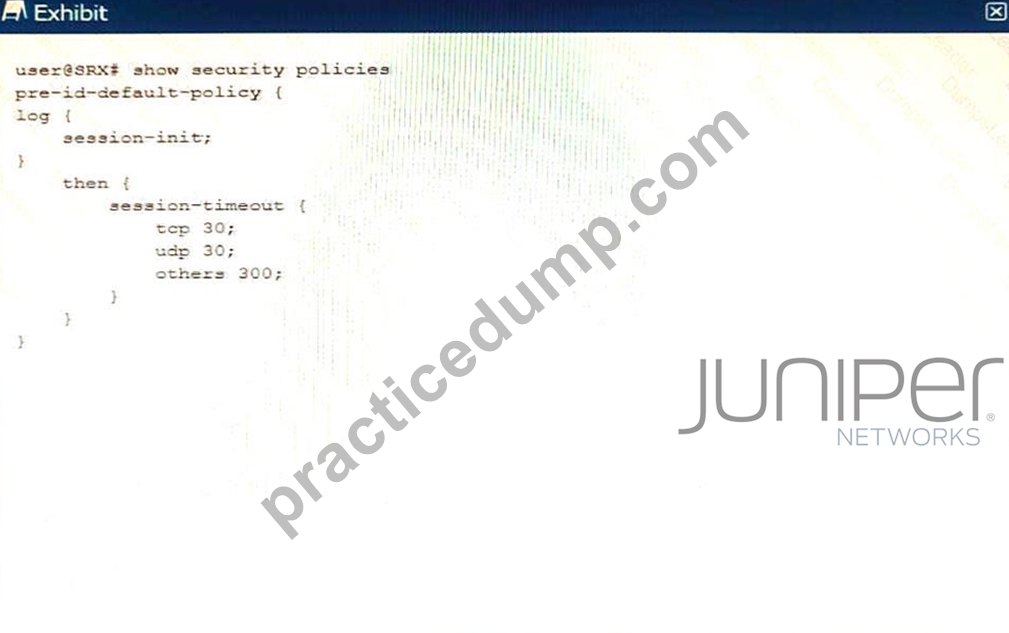
Which two statements are correct about the configuration shown in the exhibit? (Choose two.)
- A. The session-class parameter in only used when troubleshooting.
- B. Replacing the session-init parameter with session-lose will log unidentified flows.
- C. The others 300 parameter means unidentified traffic flows will be dropped in 300 milliseconds.
- D. Every session that enters the SRX Series device will generate an event
Answer: B,D
Explanation:
The log session-init; command within the policy configuration specifies that an event log entry will be created every time a session is initialized, meaning each new session will generate a log event. This is useful for tracking and analyzing the traffic flows entering the device.
Changing session-init to session-close in the log statement would mean that the device logs sessions when they close instead of when they open. This setting is typically used to log details about the session upon termination, which can help in analyzing the duration, end status, and other parameters of sessions, including those of unidentified flows.
NEW QUESTION # 53
Your manager asks you to provide firewall and NAT services in a private cloud.
Which two solutions will fulfill the minimum requirements for this deployment? (Choose two.)
- A. a cSRX for firewall services and a separate cSRX for NAT services
- B. a single cSRX
- C. a vSRX for firewall services and a separate vSRX for NAT services
- D. a single vSRX
Answer: B,D
Explanation:
A single vSRX instance is capable of handling both firewall and NAT services simultaneously. This solution provides a streamlined and resource-efficient way to secure and manage network traffic within a private cloud environment.
Similar to the vSRX, a single cSRX can also provide both firewall and NAT services. The cSRX, being a containerized version of the SRX, is particularly suited for environments where high density and microservices architectures are used, offering high performance in a compact form factor.
NEW QUESTION # 54
You administer a JSA host and want to include a rule that sets a threshold for excessive firewall denies and sends an SNMP trap after receiving related syslog messages from an SRX Series firewall.
Which JSA rule type satisfies this requirement?
- A. flow
- B. event
- C. common
- D. offense
Answer: D
Explanation:
An offense rule in JSA is designed to aggregate multiple events or log entries based on specified criteria into a single offense, which can then trigger responses such as notifications or actions like sending an SNMP trap. This type of rule is well-suited for scenarios where you need to monitor for patterns or rates of events, such as excessive firewall denies, and take action when these exceed defined thresholds.
Offense rules can analyze both event and flow data, making them highly versatile for comprehensive security monitoring.
NEW QUESTION # 55
You want to permit access to an application but block application sub.
Which two security policy features provide this capability? (Choose two.)
- A. micro application detection
- B. content filtering
- C. APPID
- D. URL filtering
Answer: A,C
Explanation:
Micro application detection is a feature that enables more granular control over applications by identifying and taking action on sub-features or specific behaviors within an application. For example, allowing access to Facebook while blocking Facebook Chat.
Application Identification (APPID) is a feature that identifies and controls applications based on their traffic patterns and characteristics. APPID can be configured to recognize not only the main application but also its various subcomponents, allowing for precise control over what is allowed or blocked.
NEW QUESTION # 56
Which statement about security policy schedulers is correct?
- A. When the scheduler is disabled, the policy will still be available.
- B. A policy without a defined scheduler will not become active
- C. Multiple policies can use the same scheduler.
- D. A policy can have multiple schedulers.
Answer: C
Explanation:
Schedulers can be defined and reused by multiple policies, allowing for more efficient management of policy activation and deactivation. This can be particularly useful for policies that need to be activated during specific time periods, such as business hours or maintenance windows.
NEW QUESTION # 57
......
JN0-336 Exam Questions and Valid PMP Dumps PDF: https://www.practicedump.com/JN0-336_actualtests.html
Juniper JN0-336 Certification Real 2026 Mock Exam: https://drive.google.com/open?id=1a-YJzxYKCmHewHCfA47SmfvqOkOcwSjr