

2025 Latest 100% Exam Passing Ratio - CAS-005 Dumps PDF
Pass Exam With Full Sureness - CAS-005 Dumps with 250 Questions
NEW QUESTION # 127
Company A acquired Company B and needs to determine how the acquisition will impact the attack surface of the organization as a whole. Which of the following is the best way to achieve this goal? (Choose two.)
- A. Performing an architectural review of Company B's network
- B. Forcing a password reset requiring more stringent passwords for users on Company B's network
- C. Documenting third-party connections used by Company B
- D. Reviewing the privacy policies currently adopted by Company B
- E. Implementing DLP controls preventing sensitive data from leaving Company B's network
- F. Requiring data sensitivity labeling tor all files shared with Company B
Answer: A,C
Explanation:
To determine how the acquisition of Company B will impact the attack surface, the following steps are crucial:
Documenting third-party connections used by Company B: Understanding all external connections is essential for assessing potential entry points for attackers and ensuring that these connections are secure.
Performing an architectural review of Company B's network: This review will identify vulnerabilities and assess the security posture of the acquired company's network, providing a comprehensive understanding of the new attack surface. These actions will provide a clear picture of the security implications of the acquisition and help in developing a plan to mitigate any identified risks.
NEW QUESTION # 128
A security professional is investigating a trend in vulnerability findings for newly deployed cloud systems Given the following output: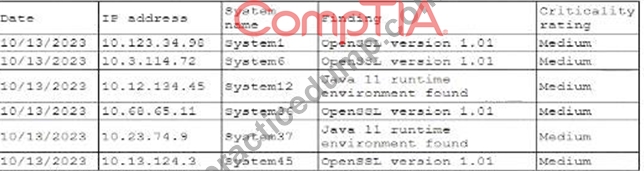
Which of the following actions would address the root cause of this issue?
- A. Automating the patching system to update base Images
- B. Deploying a WAF with virtual patching upstream of the affected systems
- C. Recompiling the affected programs with the most current patches
- D. Disabling unused/unneeded ports on all servers
Answer: A
Explanation:
The output shows that multiple systems have outdated or vulnerable software versions (OpenSSL 1.01 and Java 11 runtime). This suggests that the systems are not being patched regularly or effectively.
* A. Automating the patching system to update base images: Automating the patching process ensures that the latest security updates and patches are applied to all systems, including newly deployed ones.
This addresses the root cause by ensuring that base images used for deployment are always up-to-date with the latest security patches.
* B. Recompiling the affected programs with the most current patches: While this can fix the immediate vulnerabilities, it does not address the root cause of the problem, which is the lack of regular updates.
* C. Disabling unused/unneeded ports on all servers: This improves security but does not address the specific issue of outdated software.
* D. Deploying a WAF with virtual patching upstream of the affected systems: This can provide a temporary shield but does not resolve the underlying issue of outdated software.
Automating the patching system to update base images ensures that all deployed systems are using the latest, most secure versions of software, addressing the root cause of the vulnerability trend.
References:
* CompTIA Security+ Study Guide
* NIST SP 800-40 Rev. 3, "Guide to Enterprise Patch Management Technologies"
* CIS Controls, "Control 7: Continuous Vulnerability Management"
NEW QUESTION # 129
After remote desktop capabilities were deployed in the environment, various vulnerabilities were noticed.
* Exfiltration of intellectual property
* Unencrypted files
* Weak user passwords
Which of the following is the best way to mitigate these vulnerabilities? (Select two).
- A. Deploying file integrity monitoring
- B. Enabling modem authentication that supports MFA
- C. Implementing data loss prevention
- D. Implementing a version control system
- E. Deploying directory-based group policies
- F. Restricting access to critical file services only
- G. Implementing a CMDB platform
Answer: B,C
Explanation:
To mitigate the identified vulnerabilities, the following solutions are most appropriate:
* A. Implementing data loss prevention (DLP): DLP solutions help prevent the unauthorized transfer of data outside the organization. This directly addresses the exfiltration of intellectual property by monitoring, detecting, and blocking sensitive data transfers.
* E. Enabling modern authentication that supports Multi-Factor Authentication (MFA): This significantly enhances security by requiring additional verification methods beyond just passwords. It addresses the issue of weak user passwords by making it much harder for unauthorized users to gain access, even if they obtain the password.
Other options, while useful in specific contexts, do not address all the vulnerabilities mentioned:
* B. Deploying file integrity monitoring helps detect changes to files but does not prevent data exfiltration or address weak passwords.
* C. Restricting access to critical file services improves security but is not comprehensive enough to mitigate all identified vulnerabilities.
* D. Deploying directory-based group policies can enforce security policies but might not directly prevent data exfiltration or ensure strong authentication.
* F. Implementing a version control system helps manage changes to files but is not a security measure for preventing the identified vulnerabilities.
* G. Implementing a CMDB platform (Configuration Management Database) helps manage IT assets but does not address the specific security issues mentioned.
References:
* CompTIA Security+ Study Guide
* NIST SP 800-53 Rev. 5, "Security and Privacy Controls for Information Systems and Organizations"
* CIS Controls, "Control 13: Data Protection" and "Control 16: Account Monitoring and Control"
NEW QUESTION # 130
A company recently experienced an incident in which an advanced threat actor was able to shim malicious code against the hardware static of a domain controller The forensic team cryptographically validated that com the underlying firmware of the box and the operating system had not been compromised. However, the attacker was able to exfiltrate information from the server using a steganographic technique within LOAP Which of the following is me bset way to reduce the risk oi reoccurrence?
- A. Measuring and attesting to the entire boot chum
- B. Enforcing allow lists for authorized network pons and protocols
- C. Using code signing to verify the source of OS updates
- D. Rolling the cryptographic keys used for hardware security modules
Answer: B
Explanation:
The scenario describes a sophisticated attack where the threat actor used steganography within LDAP to exfiltrate data. Given that the hardware and OS firmware were validated and found uncompromised, the attack vector likely exploited a network communication channel. To mitigate such risks, enforcing allow lists for authorized network ports and protocols is the most effective strategy.
Here's why this option is optimal:
Port and Protocol Restrictions: By creating an allow list, the organization can restrict communications to only those ports and protocols that are necessary for legitimate business operations. This reduces the attack surface by preventing unauthorized or unusual traffic.
Network Segmentation: Enforcing such rules helps in segmenting the network and ensuring that only approved communications occur, which is critical in preventing data exfiltration methods like steganography.
Preventing Unauthorized Access: Allow lists ensure that only predefined, trusted connections are allowed, blocking potential paths that attackers could use to infiltrate or exfiltrate data.
Other options, while beneficial in different contexts, are not directly addressing the network communication threat:
B: Measuring and attesting to the entire boot chain: While this improves system integrity, it doesn't directly mitigate the risk of data exfiltration through network channels.
C: Rolling the cryptographic keys used for hardware security modules: This is useful for securing data and communications but doesn't directly address the specific method of exfiltration described.
D: Using code signing to verify the source of OS updates: Ensures updates are from legitimate sources, but it doesn't mitigate the risk of network-based data exfiltration.
References:
CompTIA SecurityX Study Guide
NIST Special Publication 800-41, "Guidelines on Firewalls and Firewall Policy" CIS Controls Version 8, Control 9: Limitation and Control of Network Ports, Protocols, and Services
NEW QUESTION # 131
You are a security analyst tasked with interpreting an Nmap scan output from company's privileged network.
The company's hardening guidelines indicate the following:
There should be one primary server or service per device.
Only default ports should be used.
Non-secure protocols should be disabled.
INSTRUCTIONS
Using the Nmap output, identify the devices on the network and their roles, and any open ports that should be closed.
For each device found by Nmap, add a device entry to the Devices Discovered list, with the following information:
The IP address of the device
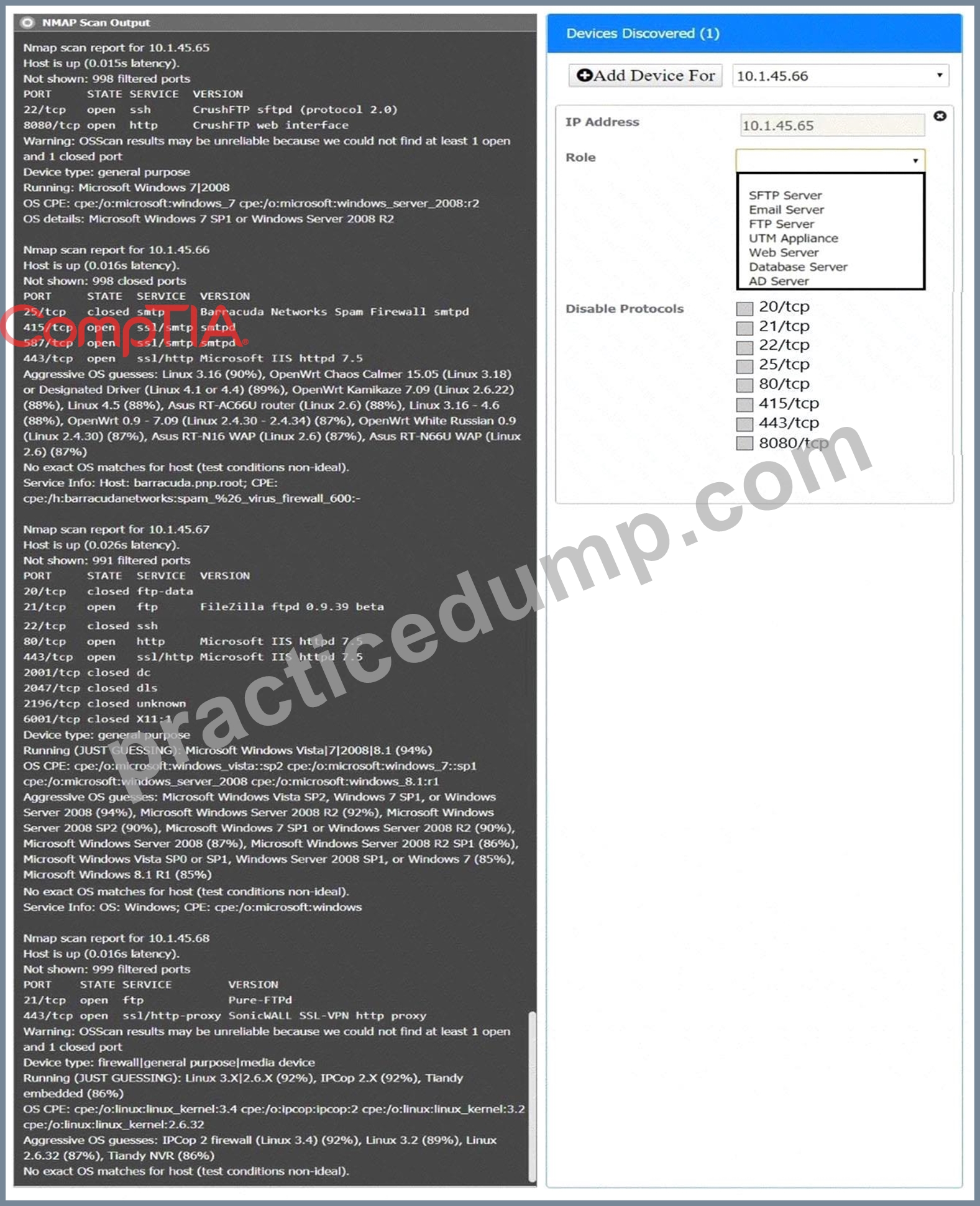
The primary server or service of the device (Note that each IP should by associated with one service/port only) The protocol(s) that should be disabled based on the hardening guidelines (Note that multiple ports may need to be closed to comply with the hardening guidelines) If at any time you would like to bring back the initial state of the simulation, please click the Reset All button.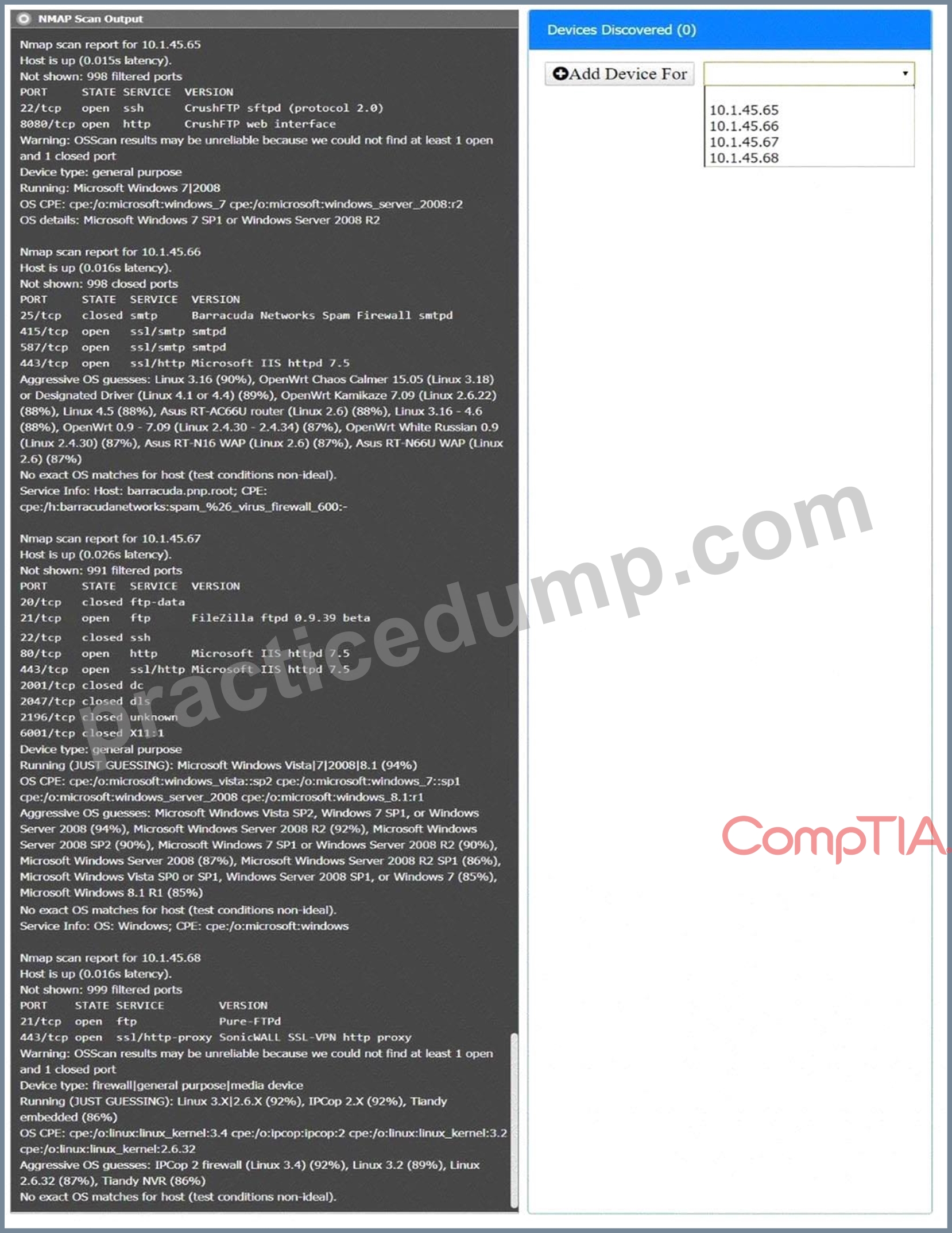
Answer:
Explanation:
10.1.45.65 SFTP ServerDisable 8080
10.1.45.66 Email Server Disable 415 and 443
10.1.45.67 Web Server Disable 21, 80
10.1.45.68 UTM Appliance Disable 21
NEW QUESTION # 132
A company migrating to a remote work model requires that company-owned devices connect to a VPN before logging in to the device itself. The VPN gateway requires that a specific key extension is deployed to the machine certificates in the internal PKI. Which of the following best explains this requirement?
- A. The internal PKI certificate deployment allows for Wi-Fi connectivity before logging in to other systems.
- B. The certificate is an additional factor to meet regulatory MFA requirements for VPN access.
- C. The server connection uses SSL VPN, which uses certificates for secure communication.
- D. The VPN client selected the certificate with the correct key usage without user interaction.
Answer: D
Explanation:
Comprehensive and Detailed
This scenario describes an enterprise VPN setup that requires machine authentication before a user logs in. The best explanation for this requirement is that the VPN client selects the appropriate certificate automatically based on the key extension in the machine certificate.
Understanding the Key Extension Requirement:
PKI (Public Key Infrastructure) issues machine certificates that include specific key usages such as Client Authentication or IPSec IKE Intermediate.
Key usage extensions define how a certificate can be used, ensuring that only valid certificates are selected by the VPN client.
Why Option B is Correct:
The VPN automatically selects the correct machine certificate with the appropriate key extension.
The process occurs without user intervention, ensuring seamless VPN authentication before login.
Why Other Options Are Incorrect:
A (MFA requirement): Certificates used in this scenario are for machine authentication, not user MFA. MFA typically involves user credentials plus a second factor (like OTPs or biometrics), which is not applicable here.
C (Wi-Fi connectivity before login): This refers to pre-logon networking, which is a separate concept where devices authenticate to a Wi-Fi network before login, usually via 802.1X EAP-TLS. However, this question specifically mentions VPN authentication, not Wi-Fi authentication.
D (SSL VPN with certificates): While SSL VPNs do use certificates, this scenario involves machine certificates issued by an internal PKI, which are commonly used in IPSec VPNs, not SSL VPNs.
Reference:
CompTIA SecurityX CAS-005 Official Study Guide: Section on Machine Certificate Authentication in VPNs NIST SP 800-53: Guidelines on authentication mechanisms
NEW QUESTION # 133
A vulnerability can on a web server identified the following:
Which of the following actions would most likely eliminate on path decryption attacks? (Select two).
- A. Increasing the key length to 256 for TLS_RSA_WITH_AES_128_CBC_SHA
- B. Implementing HIPS rules to identify and block BEAST attack attempts
- C. Disallowing cipher suites that use ephemeral modes of operation for key agreement
- D. Adding TLS_ECDHE_ECDSA_WITH_AE3_256_GCMS_HA256
- E. Removing support for CBC-based key exchange and signing algorithms
- F. Restricting cipher suites to only allow TLS_RSA_WITH_AES_128_CBC_SHA
Answer: D,E
Explanation:
On-path decryption attacks, such as BEAST (Browser Exploit Against SSL/TLS) and other related vulnerabilities, often exploit weaknesses in the implementation of CBC (Cipher Block Chaining) mode. To mitigate these attacks, the following actions are recommended:
Removing support for CBC-based key exchange and signing algorithms: CBC mode is vulnerable to certain attacks like BEAST. By removing support for CBC-based ciphers, you can eliminate one of the primary vectors for these attacks. Instead, use modern cipher modes like GCM (Galois/Counter Mode) which offer better security properties.
Adding TLS_ECDHE_ECDSA_WITH_AES_256_GCM_SHA256: This cipher suite uses Elliptic Curve Diffie-Hellman Ephemeral (ECDHE) for key exchange, which provides perfect forward secrecy. It also uses AES in GCM mode, which is not susceptible to the same attacks as CBC.
SHA-256 is a strong hash function that ensures data integrity.
NEW QUESTION # 134
A company wants to implement hardware security key authentication for accessing sensitive information systems The goal is to prevent unauthorized users from gaining access with a stolen password Which of the following models should the company implement to best solve this issue?
- A. Context-based
- B. Time-based
- C. Role based
- D. Rule based
Answer: A
Explanation:
Context-based authentication enhances traditional security methods by incorporating additional layers of information about the user's current environment and behavior. This can include factors such as the user's location, the time of access, the device used, and the behavior patterns. It is particularly useful in preventing unauthorized access even if an attacker has obtained a valid password.
* Rule-based (A) focuses on predefined rules and is less flexible in adapting to dynamic threats.
* Time-based (B) authentication considers the time factor but doesn't provide comprehensive protection against stolen credentials.
* Role-based (C) is more about access control based on the user's role within the organization rather than authenticating the user based on current context.
By implementing context-based authentication, the company can ensure that even if a password is compromised, the additional contextual factors required for access (which an attacker is unlikely to possess) provide a robust defense mechanism.
References:
* CompTIA SecurityX guide on authentication models and best practices.
* NIST guidelines on authentication and identity proofing.
* Analysis of multi-factor and adaptive authentication techniques.
NEW QUESTION # 135
An analyst reviews a SIEM and generates the following report: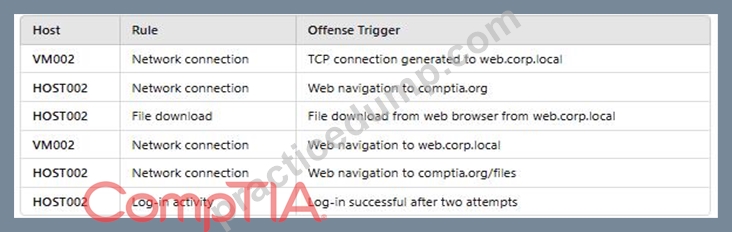
OnlyHOST002is authorized for internet traffic. Which of the following statements is accurate?
- A. The network connection activity is unusual, and a network infection is highly possible.
- B. The SIEM platform is reporting multiple false positives on the alerts.
- C. The HOST002 host is under attack, and a security incident should be declared.
- D. The VM002 host is misconfigured and needs to be revised by the network team.
Answer: A
Explanation:
Comprehensive and Detailed
Understanding the Security Event:
HOST002 is the only device authorized for internet traffic. However, theSIEM logs show that VM002 is making network connections to web.corp.local.
This indicatesunauthorized access, which could bea sign of lateral movement or network infection.
This is ared flagfor potential malware, unauthorized software, or a compromised host.
Why Option D is Correct:
Unusual network traffic patternsare often an indicator of acompromised system.
VM002 should not be communicating externally, but it is.
This suggests a possiblebreach or malware infectionattempting to communicate with a command-and-control (C2) server.
Why Other Options Are Incorrect:
A (Misconfiguration):While a misconfiguration could explain the unauthorized connections, the pattern of activity suggests something more malicious.
B (Security incident on HOST002):The issue is not with HOST002. The suspicious activity isfrom VM002.
C (False positives):The repeated pattern of unauthorized connections makes false positivesunlikely.
Reference:
CompTIASecurityX CAS-005 Official Study Guide:Chapter on SIEM & Incident Analysis MITRE ATT&CK Tactics:Lateral Movement & Network-based Attacks NIST 800-94:Guidelines for Network Intrusion Detection and Analysis
NEW QUESTION # 136
Source code snippets for two separate malware samples are shown below:
Sample 1:
knockEmDown(String e) {
if(target.isAccessed()) {
target.toShell(e);
System.out.printIn(e.toString());
c2.sendTelemetry(target.hostname.toString + " is " + e.toString());
} else {
target.close();
}
}
Sample 2:
targetSys(address a) {
if(address.islpv4()) {
address.connect(1337);
address.keepAlive("paranoid");
String status = knockEmDown(address.current);
remote.sendC2(address.current + " is " + status);
} else {
throw Exception e;
}
}
Which of the following describes the most important observation about the two samples?
- A. Telemetry is first buffered and then transmitted in paranoid mode.
- B. Sample 1 is the target agent while Sample 2 is the C2 server.
- C. Both samples use IP connectivity for command and control.
- D. The samples were probably written by the same developer.
Answer: D
Explanation:
Comprehensive and Detailed Step-by-Step Explanation:
Both samples share similar function names, variable naming styles, and logic flow, indicating that they were likely written by the same developer. This is a key observation in malware attribution, as cyber threat analysts often look for unique coding styles to link malware to specific threat actors.
The presence of C2 (Command and Control) communication in both samples supports this theory, as attackers often reuse parts of their own malware code across different attacks.
NEW QUESTION # 137
After an incident response exercise, a security administrator reviews the following table: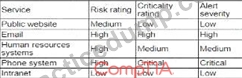
Which of the following should the administrator do to beat support rapid incident response in the future?
- A. Send emails for failed log-In attempts on the public website
- B. Enable dashboards for service status monitoring
- C. Automate alerting to IT support for phone system outages.
- D. Configure automated Isolation of human resources systems
Answer: B
Explanation:
Enabling dashboards for service status monitoring is the best action to support rapid incident response. The table shows various services with different risk, criticality, and alert severity ratings. To ensure timely and effective incident response, real-time visibility into the status of these services is crucial.
Why Dashboards for Service Status Monitoring?
Real-time Visibility: Dashboards provide an at-a-glance view of the current status of all critical services, enabling rapid detection of issues.
CentralizedMonitoring: A single platform to monitor the status of multiple services helps streamline incident response efforts.
Proactive Alerting: Dashboards can be configured to show alerts and anomalies immediately, ensuring that incidents are addressed as soon as they arise.
Improved Decision Making: Real-time data helps incident response teams make informed decisions quickly, reducing downtime and mitigating impact.
Other options, while useful, do not offer the same level of comprehensive, real-time visibility and proactive alerting:
A). Automate alerting to IT support for phone system outages: This addresses one service but does not provide a holistic view.
C). Send emails for failed log-in attempts on the public website: This is a specific alert for one type of issue and does not cover all services.
D). Configure automated isolation of human resources systems: This is a reactive measure for a specific service and does not provide real-time status monitoring.
References:
CompTIA SecurityX Study Guide
NIST Special Publication 800-61 Revision 2, "Computer Security Incident Handling Guide"
"Best Practices for Implementing Dashboards," Gartner Research
NEW QUESTION # 138
A security engineer wants to reduce the attack surface of a public-facing containerized application. Which of the following will best reduce the application's privilege escalation attack surface?
- A. Designing a muiticontainer solution, with one set of containers that runs the mam application, and another set oi containers that perform automatic remediation by replacing compromised containers or disabling compromised accounts
- B. Implementing the following commands in the Dockerfile:
RUN echo user:x:1000:1000:user:/home/user:/dev/null > /etc/passwd - C. Installing an EDR on the container's host, with reporting configured to log to a centralized SIEM, and implementing the following alerting rule:
IF PROCESS_USER==root ALERT_TYPE==critical - D. Running the container in an isolated network and placing a load balancer in a public-facing network. Adding the following ACL to the load balancer:
PERMIT HTTPS from 0.0.0.0.0/0 port 443
Answer: B
Explanation:
Implementing the given commands in the Dockerfile ensures that the container runs with non-root user privileges. Running applications as a non-root user reduces the risk of privilege escalation attacks because even if an attacker compromises the application, they would have limited privileges and would not be able to perform actions that require root access.
Implementing the following commands in the Dockerfile: This directly addresses the privilege escalation attack surface by ensuring the application does not run with elevated privileges.
NEW QUESTION # 139
A security team is responding to malicious activity and needs to determine the scope of impact the malicious activity appears to affect certain version of an application used by the organization Which of the following actions best enables the team to determine the scope of Impact?
- A. Reviewing the asset inventory
- B. Performing a port scan
- C. Analyzing user behavior
- D. Inspecting egress network traffic
Answer: A
Explanation:
Reviewing the asset inventory allows the security team to identify all instances of the affected application versions within the organization. By knowing which systems are running the vulnerable versions, the team can assess the full scope of the impact, determine which systems might be compromised, and prioritize them for further investigation and remediation.
Performing a port scan (Option A) might help identify open ports but does not provide specific information about the application versions. Inspecting egress network traffic (Option B) and analyzing user behavior (Option D) are important steps in the incident response process but do not directly identify which versions of the application are affected.
Reference:
CompTIA Security+ Study Guide
NIST SP 800-61 Rev. 2, "Computer Security Incident Handling Guide"
CIS Controls, "Control 1: Inventory and Control of Hardware Assets" and "Control 2: Inventory and Control of Software Assets"
NEW QUESTION # 140
A developer makes a small change to a resource allocation module on a popular social media website and causes a memory leak. During a peak utilization period, several web servers crash, causing the website to go offline. Which of the following testing techniques is the most efficient way to prevent this from reoccurring?
- A. Load
- B. Regression
- C. Smoke
- D. Canary
Answer: B
Explanation:
Comprehensive and Detailed Step-by-Step Explanation:
Regression testing ensures that new changes do not break existing functionality. It would have identified the memory leak before deployment, preventing downtime.
NEW QUESTION # 141
While reviewing recent modem reports, a security officer discovers that several employees were contacted by the same individual who impersonated a recruiter. Which of the following best describes this type of correlation?
- A. Spear-phishing campaign
- B. Red team assessment
- C. Threat modeling
- D. Attack pattern analysis
Answer: A
Explanation:
The situation where several employees were contacted by the same individual impersonating a recruiter best describes a spear-phishing campaign. Here's why:
Targeted Approach: Spear-phishing involves targeting specific individuals within an organization with personalized and convincing messages to trick them into divulging sensitive information or performing actions that compromise security.
Impersonation: The use of impersonation, in this case, a recruiter, is a common tactic in spear-phishing to gain the trust of the targeted individuals and increase the likelihood of a successful attack.
Correlated Contacts: The fact that several employees were contacted by the same individual suggests a coordinated effort to breach the organization's security by targeting multiple points of entry through social engineering.
NEW QUESTION # 142
A financial technology firm works collaboratively with business partners in the industry to share threat intelligence within a central platform This collaboration gives partner organizations theability to obtain and share data associated with emerging threats from a variety of adversaries Which of the following should the organization most likely leverage to facilitate this activity? (Select two).
- A. TAXII
- B. JTAG
- C. ATTACK
- D. CWPP
- E. YAKA
- F. STIX
Answer: A,F
Explanation:
D:STIX (Structured Threat Information eXpression): STIX is a standardized language for representing threat information in a structured and machine-readable format. It facilitates the sharing of threat intelligence by ensuring that data is consistent and can be easily understood by all parties involved.
E: TAXII (Trusted Automated eXchange of Indicator Information): TAXII is a transport mechanism that enables the sharing of cyber threat information over a secure and trusted network. It works in conjunction with STIX to automate the exchange of threat intelligence among organizations.
Other options:
A: CWPP (Cloud Workload Protection Platform): This focuses on securing cloud workloads and is not directly related to threat intelligence sharing.
B: YARA: YARA is used for malware research and identifying patterns in files, but it is not a platform for sharing threat intelligence.
C: ATT&CK: This is a knowledge base of adversary tactics and techniques but does not facilitate the sharing of threat intelligence data.
F: JTAG: JTAG is a standard for testing and debugging integrated circuits, not related to threat intelligence.
NEW QUESTION # 143
A company isolated its OT systems from other areas of the corporate network. These systems are required to report usage information over the internet to the vendor.
Which of the following best reduces the risk of compromise or sabotage? (Select two).
- A. Implementing allow lists
- B. Executing daily health checks
- C. Performing boot Integrity checks
- D. Implementing a site-to-site IPSec VPN
- E. Encrypting data at rest
- F. Monitoring network behavior
Answer: A,D
Explanation:
Implementing allow lists: Allow lists (whitelisting) restrict network communication to only authorized devices and applications, significantly reducing the attack surface by ensuring that only pre-approved traffic is permitted.
Implementing a site-to-site IPSec VPN: A site-to-site VPN provides a secure, encrypted tunnel for data transmission between the OT systems and the vendor, protecting the data from interception and tampering during transit.
NEW QUESTION # 144
An analyst reviews a SIEM and generates the following report:
Only HOST002 is authorized for internet traffic. Which of the following statements is accurate?
- A. The network connection activity is unusual, and a network infection is highly possible.
- B. The SIEM platform is reporting multiple false positives on the alerts.
- C. The HOST002 host is under attack, and a security incident should be declared.
- D. The VM002 host is misconfigured and needs to be revised by the network team.
Answer: A
Explanation:
Comprehensive and Detailed Explanation:
* Understanding the Security Event:
* HOST002 is the only device authorized for internet traffic. However, the SIEM logs show that VM002 is making network connections to web.corp.local.
* This indicates unauthorized access, which could be a sign of lateral movement or network infection.
* This is a red flag for potential malware, unauthorized software, or a compromised host.
* Why Option D is Correct:
* Unusual network traffic patterns are often an indicator of a compromised system.
* VM002 should not be communicating externally, but it is.
* This suggests a possible breach or malware infection attempting to communicate with a command-and-control (C2) server.
* Why Other Options Are Incorrect:
* A (Misconfiguration): While a misconfiguration could explain the unauthorized connections, the pattern of activity suggests something more malicious.
* B (Security incident on HOST002): The issue is not with HOST002. The suspicious activity is from VM002.
* C (False positives): The repeated pattern of unauthorized connections makes false positives unlikely.
NEW QUESTION # 145 
Which of the following is the security engineer most likely doing?
- A. Reporting on remote log-in activities to track team metrics
- B. Baselining user behavior to support advanced analytics
- C. Threat hunting for suspicious activity from an insider threat
- D. Assessing log in activities using geolocation to tune impossible Travel rate alerts
Answer: D
Explanation:
In the given scenario, the security engineer is likely examining login activities and their associated geolocations. This type of analysis is aimed at identifying unusual login patterns that might indicate an impossible travel scenario. An impossible travel scenario is when a single user account logs in from geographically distant locations in a short time, which is physically impossible. By assessing login activities using geolocation, the engineer can tune alerts to identify and respond to potential security breaches more effectively.
NEW QUESTION # 146
An incident response team is analyzing malware and observes the following:
* Does not execute in a sandbox
* No network loCs
* No publicly known hash match
* No process injection method detected
Which of the following should the team do next to proceed with further analysis?
- A. Utilize a new deployed machine to run the sample.
- B. Search oilier internal sources for a new sample.
- C. Check for an anti-virtualization code in the sample
- D. Use an online vims analysis tool to analyze the sample
Answer: C
Explanation:
Malware that does not execute in a sandbox environment often contains anti-analysis techniques, such as anti-virtualization code. This code detects when the malware is running in a virtualized environment and alters its behavior to avoid detection. Checking for anti-virtualization code is a logical next step because:
* It helps determine if the malware is designed to evade analysis tools.
* Identifying such code can provide insights into the malware's behavior and intent.
* This step can also inform further analysis methods, such as running the malware on physical hardware.
References:
* CompTIA Security+ Study Guide
* SANS Institute, "Malware Analysis Techniques"
* "Practical Malware Analysis" by Michael Sikorski and Andrew Honig
NEW QUESTION # 147
An organization has noticed an increase in phishing campaigns utilizing typosquatting. A security analyst needs to enrich the data for commonly used domains against the domains used in phishing campaigns. The analyst uses a log forwarder to forward network logs to the SIEM. Which of the following would allow the security analyst to perform this analysis?
- A. Create a parser that matches domains.
- B. Use a cron job to regularly update and compare domains.
- C. Implement a dashboard on the SIEM that shows the percentage of traffic by domain.
- D. Develop a query that filters out all matching domain names.
Answer: A
Explanation:
Comprehensive and Detailed Explanation:
The question addresses how a security analyst can compare legitimate domains with typosquatted domains using a SIEM (Security Information and Event Management) system.
* Understanding Typosquatting:
* Typosquatting involves registering domains with minor spelling changes to deceive users (e.g., goog1e.com instead of google.com).
* Attackers use these domains in phishing emails or malicious ads.
* Security analysts need to match legitimate domains against typosquatted domains in real- time.
* Why Option B is Correct:
* A parser is a tool that extracts structured data from logs.
* In this case, a custom parser can identify domain names in network traffic logs and compare them to known typosquatted domains.
* This approach enables real-time detection of suspicious domains in SIEM.
* Why Other Options Are Incorrect:
* A (Cron job for updates): A cron job automates scheduled tasks but does not perform real- time matching. It is inefficient for immediate detection.
* C (Query to filter matching domains): A query alone can search for known domains, but it does not continuously enrich data or handle variations of domain names dynamically.
* D (Dashboard to show domain traffic percentages): A dashboard provides visualization, not active threat detection. It does not analyze logs for typosquatting.
NEW QUESTION # 148
A company experienced a data breach, resulting in the disclosure of extremely sensitive data regarding a merger. As a regulated entity, the company must comply with reporting and disclosure requirements. The company is concerned about its public image and shareholder values. Which of the following best supports the organization in addressing its concerns?
- A. Data subject access request
- B. Crisis management plan
- C. Supply chain management program
- D. Business impact analysis
Answer: B
Explanation:
A crisis management plan defines coordinated communication and response strategies for high-profile incidents that may harm an organization's public reputation and shareholder confidence. CAS-005 GRC content includes crisis communication planning for regulatory compliance and public relations in the wake of breaches.
* A Data Subject Access Request (A) addresses individual data rights, not overall crisis handling.
* Business Impact Analysis (B) helps assess potential operational and financial impacts but does not manage public perception during an incident.
* Supply chain management (C) is preventative for vendor risks, not responsive to current crises.
NEW QUESTION # 149
A company that uses several cloud applications wants to properly identify:
All the devices potentially affected by a given vulnerability.
All the internal servers utilizing the same physical switch.
The number of endpoints using a particular operating system.Which of the following is the best way to meet the requirements?
- A. GRC
- B. CASB
- C. SBoM
- D. CMDB
Answer: D
Explanation:
Comprehensive and Detailed
The requirements demand detailed asset tracking and inventory management. Let's analyze:
A . SBoM (Software Bill of Materials):Tracks software components, not hardware or network topology.
B . CASB (Cloud Access Security Broker):Secures cloud apps but doesn't map physical switches or OS counts.
C . GRC(Governance, Risk, and Compliance):Focuses on risk management, not detailed asset tracking.
NEW QUESTION # 150
......
Verified CAS-005 dumps Q&As - 100% Pass from PracticeDump: https://www.practicedump.com/CAS-005_actualtests.html
Pass CAS-005 Exam in First Attempt Guaranteed 2025 Dumps: https://drive.google.com/open?id=1V9B_feiNSRbXu7JqGUzi4qJrYtFL1jxT