

[Nov-2021] Pass Microsoft DP-300 Exam in First Attempt Guaranteed!
Full DP-300 Practice Test and 178 unique questions with explanations waiting just for you, get it now!
NEW QUESTION 63
You have an Azure SQL Database managed instance.
The instance starts experiencing performance issues.
You need to identify which query is causing the issue and retrieve the execution plan for the query. The solution must minimize administrative effort.
What should you use?
- A. the Azure portal
- B. Extended Events
- C. Query Store
- D. dynamic management views
Answer: C
Explanation:
Reference:
https://docs.microsoft.com/en-us/sql/relational-databases/performance/monitoring-performance-by-using-the-query-store?view=sql-server-ver15
NEW QUESTION 64
You are evaluating the role assignments.
For each of the following statements, select Yes if the statement is true. Otherwise, select No.
NOTE: Each correct selection is worth one point.
Answer:
Explanation:
Explanation:
Box 1: Yes
DBAGroup1 is member of the Contributor role.
The Contributor role grants full access to manage all resources, but does not allow you to assign roles in Azure RBAC, manage assignments in Azure Blueprints, or share image galleries.
Box 2: No
Box 3: Yes
DBAGroup2 is member of the SQL DB Contributor role.
The SQL DB Contributor role lets you manage SQL databases, but not access to them. Also, you can't manage their security-related policies or their parent SQL servers. As a member of this role you can create and manage SQL databases.
Reference:
https://docs.microsoft.com/en-us/azure/role-based-access-control/built-in-roles
NEW QUESTION 65
Note: This question is part of a series of questions that present the same scenario. Each question in the series contains a unique solution that might meet the stated goals. Some question sets might have more than one correct solution, while others might not have a correct solution.
After you answer a question in this section, you will NOT be able to return to it. As a result, these questions will not appear in the review screen.
You have two Azure SQL Database servers named Server1 and Server2. Each server contains an Azure SQL database named Database1.
You need to restore Database1 from Server1 to Server2. The solution must replace the existing Database1 on Server2.
Solution: From Microsoft SQL Server Management Studio (SSMS), you rename Database1 on Server2 as Database2. From the Azure portal, you create a new database on Server2 by restoring the backup of Database1 from Server1, and then you delete Database2.
Does this meet the goal?
- A. No
- B. Yes
Answer: A
Explanation:
Instead restore Database1 from Server1 to the Server2 by using the RESTORE Transact-SQL command and the REPLACE option.
Note: REPLACE should be used rarely and only after careful consideration. Restore normally prevents accidentally overwriting a database with a different database. If the database specified in a RESTORE statement already exists on the current server and the specified database family GUID differs from the database family GUID recorded in the backup set, the database is not restored. This is an important safeguard.
Reference:
https://docs.microsoft.com/en-us/sql/t-sql/statements/restore-statements-transact-sql
NEW QUESTION 66
You have an Azure SQL database.
You are reviewing a slow performing query as shown in the following exhibit.
Use the drop-down menus to select the answer choice that completes each statement based on the information presented in the graphic.
NOTE: Each correct selection is worth one point.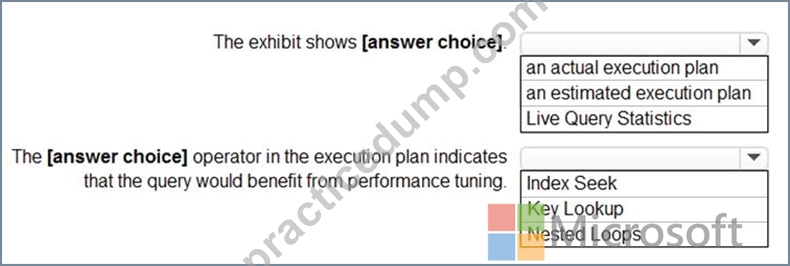
Answer:
Explanation:
Reference:
https://docs.microsoft.com/en-us/sql/relational-databases/performance/live-query-statistics?view=sql-server-ver15
NEW QUESTION 67
You have SQL Server 2019 on an Azure virtual machine that contains an SSISDB database.
A recent failure causes the master database to be lost.
You discover that all Microsoft SQL Server integration Services (SSIS) packages fail to run on the virtual machine.
Which four actions should you perform in sequence to resolve the issue? To answer, move the appropriate actions from the list of actions to the answer area and arrange them in the correct.
Answer:
Explanation:
Explanation:
Step 1: Attach the SSISDB database
Step 2: Turn on the TRUSTWORTHY property and the CLR property
If you are restoring the SSISDB database to an SQL Server instance where the SSISDB catalog was never created, enable common language runtime (clr) Step 3: Open the master key for the SSISDB database Restore the master key by this method if you have the original password that was used to create SSISDB.
open master key decryption by password = 'LS1Setup!' --'Password used when creating SSISDB' Alter Master Key Add encryption by Service Master Key Step 4: Encrypt a copy of the mater key by using the service master key Reference:
https://docs.microsoft.com/en-us/sql/integration-services/backup-restore-and-move-the-ssis-catalog
NEW QUESTION 68
HOTSPOT
You have an Azure SQL database named db1.
You need to retrieve the resource usage of db1 from the last week.
How should you complete the statement? To answer, select the appropriate options in the answer area.
NOTE: Each correct selection is worth one point.
Hot Area: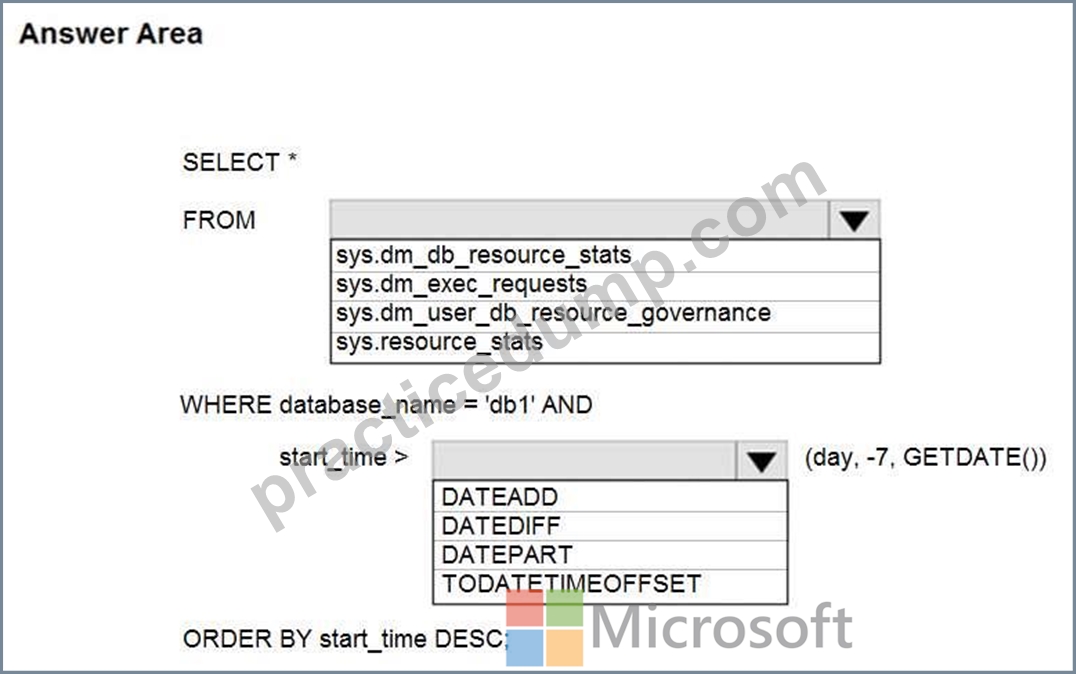
Answer:
Explanation:
Explanation:
Box 1: sys.resource_stats
sys.resource_stats returns CPU usage and storage data for an Azure SQL Database. It has database_name and start_time columns.
Box 2: DateAdd
The following example returns all databases that are averaging at least 80% of compute utilization over the last one week.
DECLARE @s datetime;
DECLARE @e datetime;
SET @s= DateAdd(d,-7,GetUTCDate());
SET @e= GETUTCDATE();
SELECT database_name, AVG(avg_cpu_percent) AS Average_Compute_Utilization FROM sys.resource_stats WHERE start_time BETWEEN @s AND @e GROUP BY database_name HAVING AVG(avg_cpu_percent) >= 80 Incorrect Answers:
sys.dm_exec_requests:
sys.dm_exec_requests returns information about each request that is executing in SQL Server. It does not have a column named database_name.
sys.dm_db_resource_stats:
sys.dm_db_resource_stats does not have any start_time column.
Note: sys.dm_db_resource_stats returns CPU, I/O, and memory consumption for an Azure SQL Database database. One row exists for every 15 seconds, even if there is no activity in the database. Historical data is maintained for approximately one hour.
Sys.dm_user_db_resource_governance returns actual configuration and capacity settings used by resource governance mechanisms in the current database or elastic pool. It does not have any start_time column.
Reference:
https://docs.microsoft.com/en-us/sql/relational-databases/system-catalog-views/sys-resource-stats-azure-sql- database Optimize Query Performance Testlet 1 This is a case study. Case studies are not timed separately. You can use as much exam time as you would like to complete each case. However, there may be additional case studies and sections on this exam. You must manage your time to ensure that you are able to complete all questions included on this exam in the time provided.
To answer the questions included in a case study, you will need to reference information that is provided in the case study. Case studies might contain exhibits and other resources that provide more information about the scenario that is described in the case study. Each question is independent of the other questions in this case study.
At the end of this case study, a review screen will appear. This screen allows you to review your answers and to make changes before you move to the next section of the exam. After you begin a new section, you cannot return to this section.
To start the case study
To display the first question in this case study, click the Next button. Use the buttons in the left pane to explore the content of the case study before you answer the questions. Clicking these buttons displays information such as business requirements, existing environment, and problem statements. If the case study has an All Information tab, note that the information displayed is identical to the information displayed on the subsequent tabs. When you are ready to answer a question, click the Question button to return to the question.
Existing Environment
Network Environment
The manufacturing and research datacenters connect to the primary datacenter by using a VPN.
The primary datacenter has an ExpressRoute connection that uses both Microsoft peering and private peering.
The private peering connects to an Azure virtual network named HubVNet.
Identity Environment
Litware has a hybrid Azure Active Directory (Azure AD) deployment that uses a domain named litwareinc.com.
All Azure subscriptions are associated to the litwareinc.com Azure AD tenant.
Database Environment
The sales department has the following database workload:
* An on-premises named SERVER1 hosts an instance of Microsoft SQL Server 2012 and two 1-TB databases.
* A logical server named SalesSrv01A contains a geo-replicated Azure SQL database named SalesSQLDb1.
SalesSQLDb1 is in an elastic pool named SalesSQLDb1Pool. SalesSQLDb1 uses database firewall rules and contained database users.
* An application named SalesSQLDb1App1 uses SalesSQLDb1.
The manufacturing office contains two on-premises SQL Server 2016 servers named SERVER2 and SERVER3. The servers are nodes in the same Always On availability group. The availability group contains a database named ManufacturingSQLDb1 Database administrators have two Azure virtual machines in HubVnet named VM1 and VM2 that run Windows Server 2019 and are used to manage all the Azure databases.
Licensing Agreement
Litware is a Microsoft Volume Licensing customer that has License Mobility through Software Assurance.
Current Problems
SalesSQLDb1 experiences performance issues that are likely due to out-of-date statistics and frequent blocking queries.
Requirements
Planned Changes
Litware plans to implement the following changes:
* Implement 30 new databases in Azure, which will be used by time-sensitive manufacturing apps that have varying usage patterns. Each database will be approximately 20 GB.
* Create a new Azure SQL database named ResearchDB1 on a logical server named ResearchSrv01.
ResearchDB1 will contain Personally Identifiable Information (PII) data.
* Develop an app named ResearchApp1 that will be used by the research department to populate and access ResearchDB1.
* Migrate ManufacturingSQLDb1 to the Azure virtual machine platform.
* Migrate the SERVER1 databases to the Azure SQL Database platform.
Technical Requirements
Litware identifies the following technical requirements:
* Maintenance tasks must be automated.
* The 30 new databases must scale automatically.
* The use of an on-premises infrastructure must be minimized.
* Azure Hybrid Use Benefits must be leveraged for Azure SQL Database deployments.
* All SQL Server and Azure SQL Database metrics related to CPU and storage usage and limits must be analyzed by using Azure built-in functionality.
Security and Compliance Requirements
Litware identifies the following security and compliance requirements:
* Store encryption keys in Azure Key Vault.
* Retain backups of the PII data for two months.
* Encrypt the PII data at rest, in transit, and in use.
* Use the principle of least privilege whenever possible.
* Authenticate database users by using Active Directory credentials.
* Protect Azure SQL Database instances by using database-level firewall rules.
* Ensure that all databases hosted in Azure are accessible from VM1 and VM2 without relying on public endpoints.
Business Requirements
Litware identifies the following business requirements:
* Meet an SLA of 99.99% availability for all Azure deployments.
* Minimize downtime during the migration of the SERVER1 databases.
* Use the Azure Hybrid Use Benefits when migrating workloads to Azure.
* Once all requirements are met, minimize costs whenever possible.
NEW QUESTION 69
You are performing exploratory analysis of bus fare data in an Azure Data Lake Storage Gen2 account by using an Azure Synapse Analytics serverless SQL pool.
You execute the Transact-SQL query shown in the following exhibit.
Use the drop-down menus to select the answer choice that completes each statement based on the information presented in the graphic.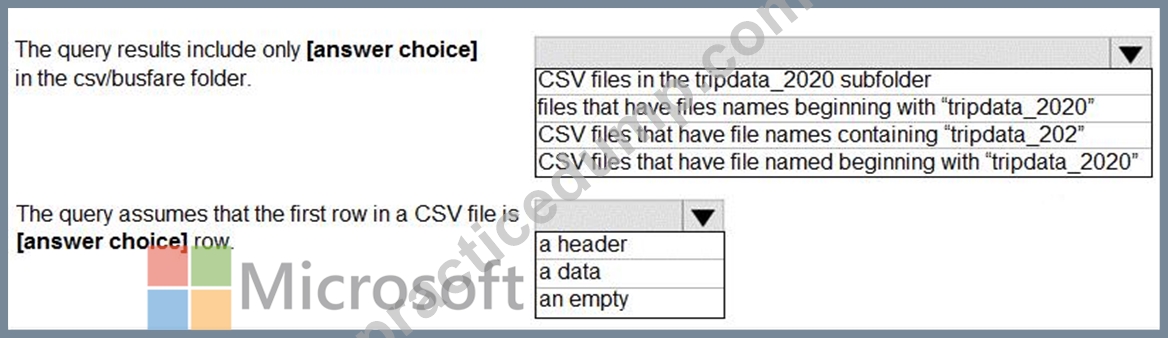
Answer:
Explanation:
Reference:
https://docs.microsoft.com/en-us/azure/synapse-analytics/sql/develop-openrowset
NEW QUESTION 70
You have an Azure SQL database named db1 on a server named server1.
You need to modify the MAXDOP settings for db1.
What should you do?
- A. Connect to db1 and run the sp_configure command.
- B. Connect to the master database of server1 and run the sp_configure command.
- C. Modify the database scoped configuration of db1.
- D. Configure the extended properties of db1.
Answer: C
Explanation:
Reference:
https://docs.microsoft.com/en-us/azure/azure-sql/database/configure-max-degree-of-parallelism
NEW QUESTION 71
Note: This question is part of a series of questions that present the same scenario. Each question in
the series contains a unique solution that might meet the stated goals. Some question sets might have
more than one correct solution, while others might not have a correct solution.
After you answer a question in this section, you will NOT be able to return to it. As a result, these
questions will not appear in the review screen.
You have two Azure SQL Database servers named Server1 and Server2. Each server contains an Azure SQL
database named Database1.
You need to restore Database1 from Server1 to Server2. The solution must replace the existing Database1 on
Server2.
Solution: From the Azure portal, you delete Database1 from Server2, and then you create a new database on
Server2 by using the backup of Database1 from Server1.
Does this meet the goal?
- A. No
- B. Yes
Answer: A
Explanation:
Section: [none]
Explanation:
Instead restore Database1 from Server1 to the Server2 by using the RESTORE Transact-SQL command and
the REPLACE option.
Note: REPLACE should be used rarely and only after careful consideration. Restore normally prevents
accidentally overwriting a database with a different database. If the database specified in a RESTORE
statement already exists on the current server and the specified database family GUID differs from the
database family GUID recorded in the backup set, the database is not restored. This is an important safeguard.
Reference:
https://docs.microsoft.com/en-us/sql/t-sql/statements/restore-statements-transact-sql
NEW QUESTION 72
What should you do after a failover of SalesSQLDb1 to ensure that the database remains accessible to SalesSQLDb1App1?
- A. Update the connection strings of SalesSQLDb1App1.
- B. Update the users in SalesSQLDb1.
- C. Configure SalesSQLDb1 as writable.
- D. Update the firewall rules of SalesSQLDb1.
Answer: D
Explanation:
Section: [none]
Explanation:
Scenario: SalesSQLDb1 uses database firewall rules and contained database users.
Testlet 2
Case study
This is a case study. Case studies are not timed separately. You can use as much exam time as you would like to complete each case. However, there may be additional case studies and sections on this exam.
You must manage your time to ensure that you are able to complete all questions included on this exam in the time provided.
To answer the questions included in a case study, you will need to reference information that is provided in the case study. Case studies might contain exhibits and other resources that provide more information about the scenario that is described in the case study. Each question is independent of the other questions in this case study.
At the end of this case study, a review screen will appear. This screen allows you to review your answers and to make changes before you move to the next section of the exam. After you begin a new section, you cannot return to this section.
To start the case study
To display the first question in this case study, click the Next button. Use the buttons in the left pane to explore the content of the case study before you answer the questions. Clicking these buttons displays information such as business requirements, existing environment, and problem statements. If the case study has an All Information tab, note that the information displayed is identical to the information displayed on the subsequent tabs. When you are ready to answer a question, click the Question button to return to the question.
Overview
General Overview
Contoso, Ltd. is a financial data company that has 100 employees. The company delivers financial data to customers.
Physical Locations
Contoso has a datacenter in Los Angeles and an Azure subscription. All Azure resources are in the US West 2 Azure region. Contoso has a 10-Gb ExpressRoute connection to Azure.
The company has customers worldwide.
Existing Environment
Active Directory
Contoso has a hybrid Azure Active Directory (Azure AD) deployment that syncs to on-premises Active Directory.
Database Environment
Contoso has SQL Server 2017 on Azure virtual machines shown in the following table.
SQL1 and SQL2 are in an Always On availability group and are actively queried. SQL3 runs jobs, provides historical data, and handles the delivery of data to customers.
The on-premises datacenter contains a PostgreSQL server that has a 50-TB database.
Current Business Model
Contoso uses Microsoft SQL Server Integration Services (SSIS) to create flat files for customers. The customers receive the files by using FTP.
Requirements
Planned Changes
Contoso plans to move to a model in which they deliver data to customer databases that run as platform as a service (PaaS) offerings. When a customer establishes a service agreement with Contoso, a separate resource group that contains an Azure SQL database will be provisioned for the customer. The database will have a complete copy of the financial data. The data to which each customer will have access will depend on the service agreement tier. The customers can change tiers by changing their service agreement.
The estimated size of each PaaS database is 1 TB.
Contoso plans to implement the following changes:
* Move the PostgreSQL database to Azure Database for PostgreSQL during the next six months.
* Upgrade SQL1, SQL2, and SQL3 to SQL Server 2019 during the next few months.
* Start onboarding customers to the new PaaS solution within six months.
Business Goals
Contoso identifies the following business requirements:
* Use built-in Azure features whenever possible.
* Minimize development effort whenever possible.
* Minimize the compute costs of the PaaS solutions.
* Provide all the customers with their own copy of the database by using the PaaS solution.
* Provide the customers with different table and row access based on the customer's service agreement.
* In the event of an Azure regional outage, ensure that the customers can access the PaaS solution with minimal downtime. The solution must provide automatic failover.
* Ensure that users of the PaaS solution can create their own database objects but be prevented from modifying any of the existing database objects supplied by Contoso.
Technical Requirements
Contoso identifies the following technical requirements:
* Users of the PaaS solution must be able to sign in by using their own corporate Azure AD credentials or have Azure AD credentials supplied to them by Contoso. The solution must avoid using the internal Azure AD of Contoso to minimize guest users.
* All customers must have their own resource group, Azure SQL server, and Azure SQL database. The deployment of resources for each customer must be done in a consistent fashion.
* Users must be able to review the queries issued against the PaaS databases and identify any new objects created.
* Downtime during the PostgreSQL database migration must be minimized.
Monitoring Requirements
Contoso identifies the following monitoring requirements:
* Notify administrators when a PaaS database has a higher than average CPU usage.
* Use a single dashboard to review security and audit data for all the PaaS databases.
* Use a single dashboard to monitor query performance and bottlenecks across all the PaaS databases.
* Monitor the PaaS databases to identify poorly performing queries and resolve query performance issues automatically whenever possible.
PaaS Prototype
During prototyping of the PaaS solution in Azure, you record the compute utilization of a customer's Azure SQL database as shown in the following exhibit.
Role Assignments
For each customer's Azure SQL Database server, you plan to assign the roles shown in the following exhibit.
NEW QUESTION 73
HOTSPOT
You need to implement the monitoring of SalesSQLDb1. The solution must meet the technical requirements.
How should you collect and stream metrics? To answer, select the appropriate options in the answer area.
NOTE: Each correct selection is worth one point.
Hot Area:
Answer:
Explanation:
Section: [none]
Explanation:
Box 1: The server, the elastic pool, and the database
Senario:
SalesSQLDb1 is in an elastic pool named SalesSQLDb1Pool.
Litware technical requirements include: all SQL Server and Azure SQL Database metrics related to CPU and
storage usage and limits must be analyzed by using Azure built-in functionality.
Box 2: Azure Event hubs
Scenario: Migrate ManufacturingSQLDb1 to the Azure virtual machine platform.
Event hubs are able to handle custom metrics.
Incorrect Answers:
Azure Log Analytics
Azure metric and log data are sent to Azure Monitor Logs, previously known as Azure Log Analytics, directly by
Azure. Azure SQL Analytics is a cloud only monitoring solution supporting streaming of diagnostics telemetry
for all of your Azure SQL databases.
However, because Azure SQL Analytics does not use agents to connect to Azure Monitor, it does not support
monitoring of SQL Server hosted on-premises or in virtual machines.
Testlet 2
Case study
This is a case study. Case studies are not timed separately. You can use as much exam time as you
would like to complete each case. However, there may be additional case studies and sections on this exam.
You must manage your time to ensure that you are able to complete all questions included on this exam in the
time provided.
To answer the questions included in a case study, you will need to reference information that is provided in the
case study. Case studies might contain exhibits and other resources that provide more information about the
scenario that is described in the case study. Each question is independent of the other questions in this case
study.
At the end of this case study, a review screen will appear. This screen allows you to review your answers and to
make changes before you move to the next section of the exam. After you begin a new section, you cannot
return to this section.
To start the case study
To display the first question in this case study, click the Next button. Use the buttons in the left pane to explore
the content of the case study before you answer the questions. Clicking these buttons displays information such
as business requirements, existing environment, and problem statements. If the case study has an All
Information tab, note that the information displayed is identical to the information displayed on the subsequent
tabs. When you are ready to answer a question, click the Question button to return to the question.
Overview
Existing Environment
Contoso, Ltd. is a financial data company that has 100 employees. The company delivers financial data to
customers.
Active Directory
Contoso has a hybrid Azure Active Directory (Azure AD) deployment that syncs to on-premises Active
Directory.
Database Environment
Contoso has SQL Server 2017 on Azure virtual machines shown in the following table.
SQL1 and SQL2 are in an Always On availability group and are actively queried. SQL3 runs jobs, provides
historical data, and handles the delivery of data to customers.
The on-premises datacenter contains a PostgreSQL server that has a 50-TB database.
Current Business Model
Contoso uses Microsoft SQL Server Integration Services (SSIS) to create flat files for customers. The
customers receive the files by using FTP.
Requirements
Planned Changes
Contoso plans to move to a model in which they deliver data to customer databases that run as platform as a
service (PaaS) offerings. When a customer establishes a service agreement with Contoso, a separate resource
group that contains an Azure SQL database will be provisioned for the customer. The database will have a
complete copy of the financial data. The data to which each customer will have access will depend on the
service agreement tier. The customers can change tiers by changing their service agreement.
The estimated size of each PaaS database is 1 TB.
Contoso plans to implement the following changes:
* Move the PostgreSQL database to Azure Database for PostgreSQL during the next six months.
* Upgrade SQL1, SQL2, and SQL3 to SQL Server 2019 during the next few months.
* Start onboarding customers to the new PaaS solution within six months.
Business Goals
Contoso identifies the following business requirements:
* Use built-in Azure features whenever possible.
* Minimize development effort whenever possible.
* Minimize the compute costs of the PaaS solutions.
* Provide all the customers with their own copy of the database by using the PaaS solution.
* Provide the customers with different table and row access based on the customer's service agreement.
* In the event of an Azure regional outage, ensure that the customers can access the PaaS solution with
minimal downtime. The solution must provide automatic failover.
* Ensure that users of the PaaS solution can create their own database objects but he prevented from
modifying any of the existing database objects supplied by Contoso.
Technical Requirements
Contoso identifies the following technical requirements:
* Users of the PaaS solution must be able to sign in by using their own corporate Azure AD credentials or
have Azure AD credentials supplied to them by Contoso. The solution must avoid using the internal Azure
AD of Contoso to minimize guest users.
* All customers must have their own resource group, Azure SQL server, and Azure SQL database. The
deployment of resources for each customer must be done in a consistent fashion.
* Users must be able to review the queries issued against the PaaS databases and identify any new objects
created.
* Downtime during the PostgreSQL database migration must be minimized.
Monitoring Requirements
Contoso identifies the following monitoring requirements:
* Notify administrators when a PaaS database has a higher than average CPU usage.
* Use a single dashboard to review security and audit data for all the PaaS databases.
* Use a single dashboard to monitor query performance and bottlenecks across all the PaaS databases.
* Monitor the PaaS databases to identify poorly performing queries and resolve query performance issues
automatically whenever possible.
PaaS Prototype
During prototyping of the PaaS solution in Azure, you record the compute utilization of a customer's Azure SQL
database as shown in the following exhibit.
Role Assignments
For each customer's Azure SQL Database server, you plan to assign the roles shown in the following exhibit.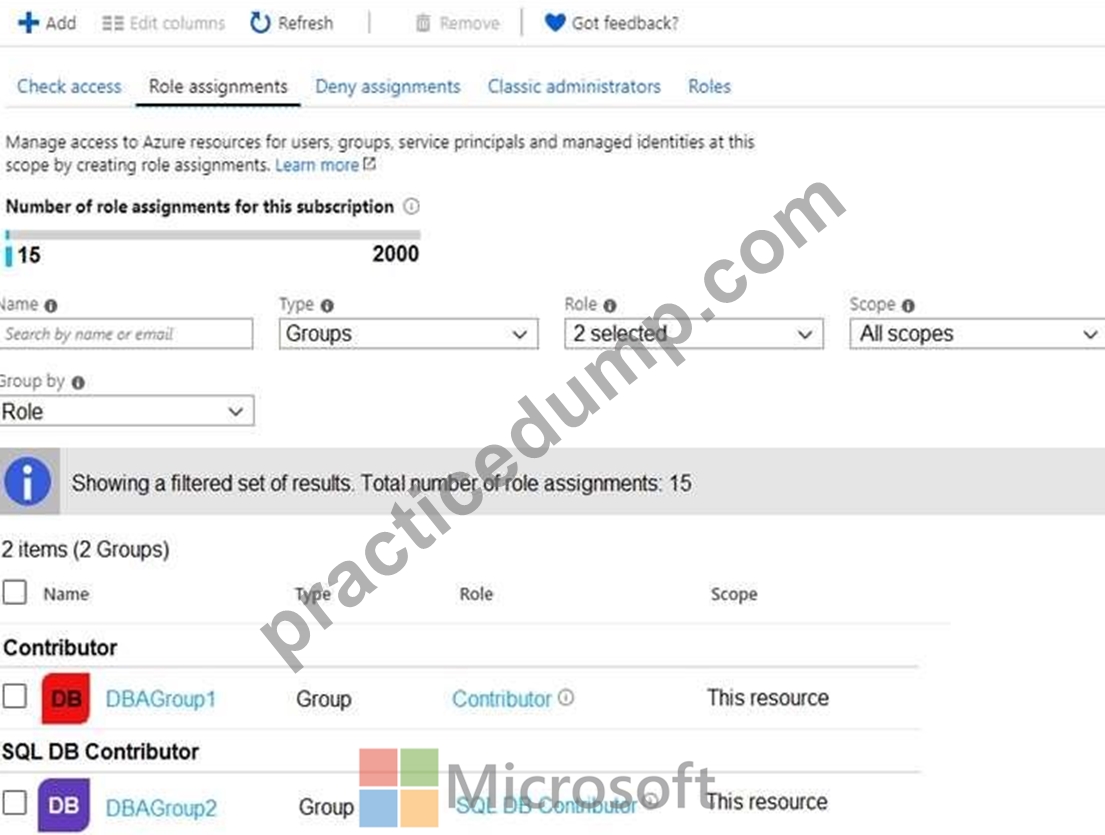
NEW QUESTION 74
You have an Azure SQL database that contains a table named Customer. Customer has the columns shown in the following table.
You plan to implement a dynamic data mask for the Customer_Phone column. The mask must meet the following requirements:
The first six numerals of each customer's phone number must be masked.
The last four digits of each customer's phone number must be visible.
Hyphens must be preserved and displayed.
How should you configure the dynamic data mask? To answer, select the appropriate options in the answer area.
Answer:
Explanation:
Reference:
https://docs.microsoft.com/en-us/sql/relational-databases/security/dynamic-data-masking
NEW QUESTION 75
HOTSPOT
You have an Azure SQL Database managed instance named sqldbmi1 that contains a database name Sales.
You need to initiate a backup of Sales.
How should you complete the Transact-SQL statement? To answer, select the appropriate options in the answer area.
NOTE: Each correct selection is worth one point.
Hot Area:
Answer:
Explanation:
Section: [none]
Explanation:
Box 1: TO URL = 'https://storage1.blob.core.windows.net/blob1/Sales.bak' Native database backup in Azure SQL Managed Instance.
You can backup any database using standard BACKUP T-SQL command:
BACKUP DATABASE tpcc2501
TO URL = 'https://myacc.blob.core.windows.net/testcontainer/tpcc2501.bak' WITH COPY_ONLY Box 2: WITH COPY_ONLY Reference:
https://techcommunity.microsoft.com/t5/azure-sql-database/native-database-backup-in-azure-sql-managed- instance/ba-p/386154
NEW QUESTION 76
You deploy a database to an Azure SQL Database managed instance.
You need to prevent read queries from blocking queries that are trying to write to the database.
Which database option should set?
- A. PARAMETERIZATIONto FORCED
- B. READ_COMMITTED_SNAPSHOTto ON
- C. Delayed Durability to Forced
- D. PARAMETERIZATIONto SIMPLE
Answer: B
Explanation:
Section: [none]
Explanation:
In SQL Server, you can also minimize locking contention while protecting transactions from dirty reads of uncommitted data modifications using either:
* The READ COMMITTED isolation level with the READ_COMMITTED_SNAPSHOT database option set to ON.
* The SNAPSHOT isolation level.
If READ_COMMITTED_SNAPSHOT is set to ON (the default on SQL Azure Database), the Database Engine uses row versioning to present each statement with a transactionally consistent snapshot of the data as it existed at the start of the statement. Locks are not used to protect the data from updates by other transactions.
Incorrect Answers:
A: When the PARAMETERIZATION database option is set to SIMPLE, the SQL Server query optimizer may choose to parameterize the queries. This means that any literal values that are contained in a query are substituted with parameters. This process is referred to as simple parameterization. When SIMPLE parameterization is in effect, you cannot control which queries are parameterized and which queries are not.
B: You can specify that all queries in a database be parameterized by setting the PARAMETERIZATION database option to FORCED. This process is referred to as forced parameterization.
C: Delayed transaction durability is accomplished using asynchronous log writes to disk. Transaction log records are kept in a buffer and written to disk when the buffer fills or a buffer flushing event takes place.
Delayed transaction durability reduces both latency and contention within the system.
Some of the cases in which you could benefit from using delayed transaction durability are:
* You can tolerate some data loss.
* You are experiencing a bottleneck on transaction log writes.
* Your workloads have a high contention rate.
Reference:
https://docs.microsoft.com/en-us/sql/t-sql/statements/set-transaction-isolation-level-transact-sql
NEW QUESTION 77
You have an Azure Synapse Analytics dedicated SQL pool.
You run PDW_SHOWSPACEUSED('dbo.FactInternetSales'); and get the results shown in the following table.
Which statement accurately describes the dbo.FactInternetSales table?
- A. The table is skewed.
- B. The table uses round-robin distribution
- C. The table contains less than 10,000 rows.
- D. All distributions contain data.
Answer: A
Explanation:
The rows per distribution can vary up to 10% without a noticeable impact on performance. Here the distribution varies more than 10%. It is skewed.
Note: SHOWSPACEUSED displays the number of rows, disk space reserved, and disk space used for a specific table, or for all tables in a Azure Synapse Analytics or Parallel Data Warehouse database.
This is a very quick and simple way to see the number of table rows that are stored in each of the 60 distributions of your database. Remember that for the most balanced performance, the rows in your distributed table should be spread evenly across all the distributions.
ROUND_ROBIN distributed tables should not be skewed. Data is distributed evenly across the nodes by design.
Reference:
https://docs.microsoft.com/en-us/azure/synapse-analytics/sql-data-warehouse/sql-data-warehouse-tables-distribute
https://github.com/rgl/azure-content/blob/master/articles/sql-data-warehouse/sql-data-warehouse-manage-distributed-data-skew.md
NEW QUESTION 78
You need to implement a solution to notify the administrators. The solution must meet the monitoring requirements.
What should you do?
- A. Create an Azure Monitor alert rule that has a dynamic threshold and assign the alert rule to an action group.
- B. Add a diagnostic setting that logs Timeouts and streams to an Azure event hub.
- C. Create an Azure Monitor alert rule that has a static threshold and assign the alert rule to an action group.
- D. Add a diagnostic setting that logs QueryStoreRuntimeStatistics and streams to an Azure event hub.
Answer: A
Explanation:
Reference:
https://azure.microsoft.com/en-gb/blog/announcing-azure-monitor-aiops-alerts-with-dynamic-thresholds/ This is a case study. Case studies are not timed separately. You can use as much exam time as you would like to complete each case. However, there may be additional case studies and sections on this exam. You must manage your time to ensure that you are able to complete all questions included on this exam in the time provided.
To answer the questions included in a case study, you will need to reference information that is provided in the case study. Case studies might contain exhibits and other resources that provide more information about the scenario that is described in the case study. Each question is independent of the other questions in this case study.
At the end of this case study, a review screen will appear. This screen allows you to review your answers and to make changes before you move to the next section of the exam. After you begin a new section, you cannot return to this section.
To start the case study
To display the first question in this case study, click the Next button. Use the buttons in the left pane to explore the content of the case study before you answer the questions. Clicking these buttons displays information such as business requirements, existing environment, and problem statements. If the case study has an All Information tab, note that the information displayed is identical to the information displayed on the subsequent tabs. When you are ready to answer a question, click the Question button to return to the question.
Overview
ADatum Corporation is a retailer that sells products through two sales channels: retail stores and a website.
NEW QUESTION 79
You have an Azure virtual machine based on a custom image named VM1.
VM1 hosts an instance of Microsoft SQL Server 2019 Standard.
You need to automate the maintenance of VM1 to meet the following requirements:
* Automate the patching of SQL Server and Windows Server.
* Automate full database backups and transaction log backups of the databases on VM1.
* Minimize administrative effort.
What should you do first?
- A. Register VM1 to the Microsoft.Sql resource provider
- B. Register VM1 to the Microsoft.SqlVirtualMachine resource provider
- C. Enable a system-assigned managed identity for VM1
- D. Install an Azure virtual machine Desired State Configuration (DSC) extension on VM1
Answer: A
Explanation:
Section: [none]
Explanation:
Automated Patching depends on the SQL Server infrastructure as a service (IaaS) Agent Extension. The SQL
Server IaaS Agent Extension (SqlIaasExtension) runs on Azure virtual machines to automate administration
tasks. The SQL Server IaaS extension is installed when you register your SQL Server VM with the SQL Server
VM resource provider.
Reference:
https://docs.microsoft.com/en-us/azure/azure-sql/virtual-machines/windows/sql-server-iaas-agent-extension-
automate-management
NEW QUESTION 80
Note: This question is part of a series of questions that present the same scenario. Each question in the series contains a unique solution that might meet the stated goals. Some question sets might have more than one correct solution, while others might not have a correct solution.
After you answer a question in this section, you will NOT be able to return to it. As a result, these questions will not appear in the review screen.
You have an Azure Data Lake Storage account that contains a staging zone.
You need to design a daily process to ingest incremental data from the staging zone, transform the data by executing an R script, and then insert the transformed data into a data warehouse in Azure Synapse Analytics.
Solution: You use an Azure Data Factory schedule trigger to execute a pipeline that executes an Azure Databricks notebook, and then inserts the data into the data warehouse.
Does this meet the goal?
- A. No
- B. Yes
Answer: A
Explanation:
Section: [none]
Explanation:
If you need to transform data in a way that is not supported by Data Factory, you can create a custom activity, not an Azure Databricks notebook, with your own data processing logic and use the activity in the pipeline. You can create a custom activity to run R scripts on your HDInsight cluster with R installed.
Reference:
https://docs.microsoft.com/en-US/azure/data-factory/transform-data
NEW QUESTION 81
You have 10 Azure virtual machines that have SQL Server installed.
You need to implement a backup strategy to ensure that you can restore specific databases to other SQL
Server instances. The solution must provide centralized management of the backups.
What should you include in the backup strategy?
- A. Azure Backup
- B. Azure Site Recovery
- C. SQL Server Agent jobs
- D. Automated Backup in the SQL virtual machine settings
Answer: A
Explanation:
Section: [none]
Explanation:
Azure Backup provides an Enterprise class backup capability for SQL Server on Azure VMs. All backups are
stored and managed in a Recovery Services vault. There are several advantages that this solution provides,
especially for Enterprises.
Reference:
https://docs.microsoft.com/en-us/azure/azure-sql/virtual-machines/windows/backup-restore#azbackup
NEW QUESTION 82
HOTSPOT
You have an Azure SQL database named DB1. The automatic tuning options for DB1 are configured as shown
in the following exhibit.
For each of the following statements, select Yes if the statement is true. Otherwise, select No.
NOTE: Each correct selection is worth one point.
Hot Area:
Answer:
Explanation: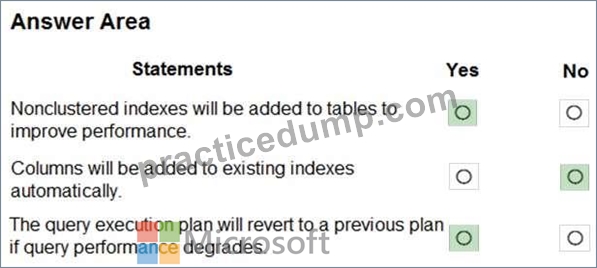
Section: [none]
Explanation:
Box 1: Yes
We see: Tuning option: Create index ON
CREATE INDEX - Identifies indexes that may improve performance of your workload, creates indexes, and
automatically verifies that performance of queries has improved.
Box 2: No
Box 3: Yes
FORCE LAST GOOD PLAN (automatic plan correction) - Identifies Azure SQL queries using an execution plan
that is slower than the previous good plan, and queries using the last known good plan instead of the regressed
plan.
NEW QUESTION 83
You have an Azure Synapse Analytics dedicated SQL pool named Pool1 and an Azure Data Lake Storage Gen2 account named Account1.
You plan to access the files in Account1 by using an external table.
You need to create a data source in Pool1 that you can reference when you create the external table.
How should you complete the Transact-SQL statement? To answer, select the appropriate options in the answer area.
NOTE: Each correct selection is worth one point.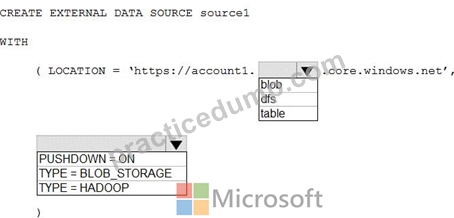
Answer:
Explanation:
Reference:
https://docs.microsoft.com/en-us/azure/synapse-analytics/sql/develop-tables-external-tables
NEW QUESTION 84
You need to apply 20 built-in Azure Policy definitions to all new and existing Azure SQL Database deployments in an Azure subscription. The solution must minimize administrative effort.
Which three actions should you perform in sequence? To answer, move the appropriate actions from the list of actions to the answer area and arrange them in the correct order.
Answer:
Explanation:
1 - Create an Azure Policy Initiative
2 - Create an Azure Policy Initiative assignment
3 - Run Azure Policy remediation tasks
Reference:
https://docs.microsoft.com/en-us/azure/governance/policy/tutorials/create-and-manage
NEW QUESTION 85
HOTSPOT
You need to recommend the appropriate purchasing model and deployment option for the 30 new databases.
The solution must meet the technical requirements and the business requirements.
What should you recommend? To answer, select the appropriate options in the answer area.
NOTE: Each correct selection is worth one point.
Hot Area:
Answer:
Explanation: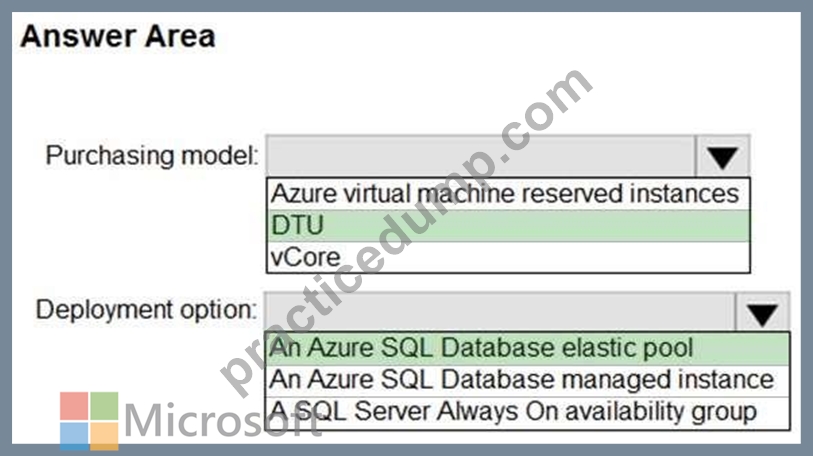
Section: [none]
Explanation:
Box 1: DTU
Scenario:
* The 30 new databases must scale automatically.
* Once all requirements are met, minimize costs whenever possible.
You can configure resources for the pool based either on the DTU-based purchasing model or the vCore-based purchasing model.
In short, for simplicity, the DTU model has an advantage. Plus, if you're just getting started with Azure SQL Database, the DTU model offers more options at the lower end of performance, so you can get started at a lower price point than with vCore.
Box 2: An Azure SQL database elastic pool
Azure SQL Database elastic pools are a simple, cost-effective solution for managing and scaling multiple databases that have varying and unpredictable usage demands. The databases in an elastic pool are on a single server and share a set number of resources at a set price. Elastic pools in Azure SQL Database enable SaaS developers to optimize the price performance for a group of databases within a prescribed budget while delivering performance elasticity for each database.
Reference:
https://docs.microsoft.com/en-us/azure/azure-sql/database/elastic-pool-overview
https://docs.microsoft.com/en-us/azure/azure-sql/database/reserved-capacity-overview Testlet 2 This is a case study. Case studies are not timed separately. You can use as much exam time as you would like to complete each case. However, there may be additional case studies and sections on this exam.
You must manage your time to ensure that you are able to complete all questions included on this exam in the time provided.
To answer the questions included in a case study, you will need to reference information that is provided in the case study. Case studies might contain exhibits and other resources that provide more information about the scenario that is described in the case study. Each question is independent of the other questions in this case study.
At the end of this case study, a review screen will appear. This screen allows you to review your answers and to make changes before you move to the next section of the exam. After you begin a new section, you cannot return to this section.
To start the case study
To display the first question in this case study, click the Next button. Use the buttons in the left pane to explore the content of the case study before you answer the questions. Clicking these buttons displays information such as business requirements, existing environment, and problem statements. If the case study has an All Information tab, note that the information displayed is identical to the information displayed on the subsequent tabs. When you are ready to answer a question, click the Question button to return to the question.
Overview
Contoso, Ltd. is a clothing retailer based in Seattle. The company has 2,000 retail stores across the United States and an emerging online presence.
The network contains an Active Directory forest named contoso.com. The forest is integrated with an Azure Active Directory (Azure AD) tenant named contoso.com. Contoso has an Azure subscription associated to the contoso.com Azure AD tenant.
Existing Environment
Transactional Data
Contoso has three years of customer, transaction, operational, sourcing, and supplier data comprised of 10 billion records stored across multiple on-premises Microsoft SQL Server servers. The SQL Server instances contain data from various operations systems. The data is loaded into the instances by using SQL Server Integration Services (SSIS) packages.
You estimate that combining all product sales transactions into a company-wide sales transactions dataset will result in a single table that contains 5 billion rows, with one row per transaction.
Most queries targeting the sales transactions data will be used to identify which products were sold in retail stores and which products were sold online during different time periods. Sales transaction data that is older than three years will be removed monthly.
You plan to create a retail store table that will contain the address of each retail store. The table will be approximately 2 MB. Queries for retail store sales will include the retail store addresses.
You plan to create a promotional table that will contain a promotion ID. The promotion ID will be associated to a specific product. The product will be identified by a product ID. The table will be approximately 5 GB.
Streaming Twitter Data
The ecommerce department at Contoso develops an Azure logic app that captures trending Twitter feeds referencing the company's products and pushes the products to Azure Event Hubs.
Planned Changes and Requirements
Planned Changes
Contoso plans to implement the following changes:
* Load the sales transaction dataset to Azure Synapse Analytics.
* Integrate on-premises data stores with Azure Synapse Analytics by using SSIS packages.
* Use Azure Synapse Analytics to analyze Twitter feeds to assess customer sentiments about products.
Sales Transaction Dataset Requirements
Contoso identifies the following requirements for the sales transaction dataset:
* Partition data that contains sales transaction records. Partitions must be designed to provide efficient loads by month. Boundary values must belong to the partition on the right.
* Ensure that queries joining and filtering sales transaction records based on product ID complete as quickly as possible.
* Implement a surrogate key to account for changes to the retail store addresses.
* Ensure that data storage costs and performance are predictable.
* Minimize how long it takes to remove old records.
Customer Sentiment Analytics Requirements
Contoso identifies the following requirements for customer sentiment analytics:
* Allow Contoso users to use PolyBase in an Azure Synapse Analytics dedicated SQL pool to query the content of the data records that host the Twitter feeds. Data must be protected by using row-level security (RLS). The users must be authenticated by using their own Azure AD credentials.
* Maximize the throughput of ingesting Twitter feeds from Event Hubs to Azure Storage without purchasing additional throughput or capacity units.
* Store Twitter feeds in Azure Storage by using Event Hubs Capture. The feeds will be converted into Parquet files.
* Ensure that the data store supports Azure AD-based access control down to the object level.
* Minimize administrative effort to maintain the Twitter feed data records.
* Purge Twitter feed data records that are older than two years.
Data Integration Requirements
Contoso identifies the following requirements for data integration:
* Use an Azure service that leverages the existing SSIS packages to ingest on-premises data into datasets stored in a dedicated SQL pool of Azure Synapse Analytics and transform the data.
* Identify a process to ensure that changes to the ingestion and transformation activities can be version- controlled and developed independently by multiple data engineers.
NEW QUESTION 86
You have an Azure SQL database.
Users report that the executions of a stored procedure are slower than usual. You suspect that a regressed
query is causing the performance issue.
You need to view the query execution plan to verify whether a regressed query is causing the issue. The
solution must minimize effort.
What should you use?
- A. Performance Recommendations in the Azure portal
- B. Query Performance Insight in the Azure portal
- C. Extended Events in Microsoft SQL Server Management Studio (SSMS)
- D. Query Store in Microsoft SQL Server Management Studio (SSMS)
Answer: D
Explanation:
Section: [none]
Explanation:
Use the Query Store Page in SQL Server Management Studio.
Query performance regressions caused by execution plan changes can be non-trivial and time consuming to
resolve.
Since the Query Store retains multiple execution plans per query, it can enforce policies to direct the Query
Processor to use a specific execution plan for a query. This is referred to as plan forcing. Plan forcing in Query
Store is provided by using a mechanism similar to the USE PLAN query hint, but it does not require any change
in user applications. Plan forcing can resolve a query performance regression caused by a plan change in a
very short period of time.
Reference:
https://docs.microsoft.com/en-us/sql/relational-databases/performance/monitoring-performance-by-using-the-
query-store
NEW QUESTION 87
You have SQL Server on an Azure virtual machine that contains a database named DB1. DB1 is 30 TB and has a 1-GB daily rate of change.
You back up the database by using a Microsoft SQL Server Agent job that runs Transact-SQL commands. You perform a weekly full backup on Sunday, daily differential backups at 01:00, and transaction log backups every five minutes.
The database fails on Wednesday at 10:00.
Which three backups should you restore in sequence? To answer, move the appropriate backups from the list of backups to the answer area and arrange them in the correct order.
Answer:
Explanation: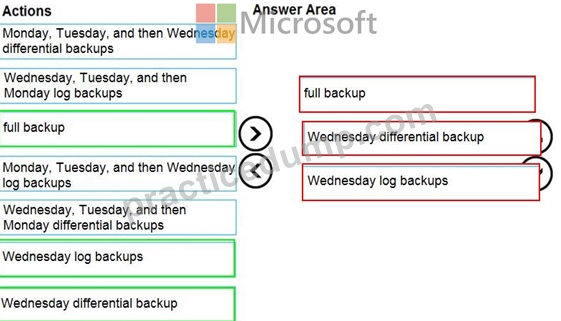
NEW QUESTION 88
......
Prepare for your Microsoft certification with the updated PracticeDump DP-300 exam questions: https://drive.google.com/open?id=1tWcSlVk3ho41j_W_KQrjoKL49mTctc15
Get Latest DP-300 Dumps Exam Questions in here: https://www.practicedump.com/DP-300_actualtests.html