

[Oct-2021] Pass Microsoft DP-300 Exam in First Attempt Guaranteed!
Full DP-300 Practice Test and 178 unique questions with explanations waiting just for you, get it now!
NEW QUESTION 97
From a website analytics system, you receive data extracts about user interactions such as downloads, link clicks, form submissions, and video plays.
The data contains the following columns:
You need to design a star schema to support analytical queries of the dat a. The star schema will contain four tables including a date dimension.
To which table should you add each column? To answer, select the appropriate options in the answer area.
NOTE: Each correct selection is worth one point.
Answer:
Explanation:
Reference:
https://docs.microsoft.com/en-us/power-bi/guidance/star-schema
NEW QUESTION 98
You have a data warehouse in Azure Synapse Analytics.
You need to ensure that the data in the data warehouse is encrypted at rest.
What should you enable?
- A. Advanced Data Security for this database
- B. Transparent Data Encryption (TDE)
- C. Secure transfer required
- D. Always Encrypted for all columns
Answer: B
Explanation:
Transparent data encryption (TDE) helps protect Azure SQL Database, Azure SQL Managed Instance, and Azure Synapse Analytics against the threat of malicious offline activity by encrypting data at rest.
Reference:
https://docs.microsoft.com/en-us/azure/azure-sql/database/transparent-data-encryption-tde-overview
NEW QUESTION 99
You are evaluating the role assignments.
For each of the following statements, select Yes if the statement is true. Otherwise, select No.
NOTE: Each correct selection is worth one point.
Answer:
Explanation:
Reference:
https://docs.microsoft.com/en-us/azure/role-based-access-control/built-in-roles
NEW QUESTION 100
You need to design a data retention solution for the Twitter feed data records. The solution must meet the customer sentiment analytics requirements.
Which Azure Storage functionality should you include in the solution?
- A. change feed
- B. soft delete
- C. time-based retention
- D. lifecycle management
Answer: D
Explanation:
The lifecycle management policy lets you:
Delete blobs, blob versions, and blob snapshots at the end of their lifecycles Reference:
https://docs.microsoft.com/en-us/azure/storage/blobs/storage-lifecycle-management-concepts
NEW QUESTION 101
You have SQL Server on an Azure virtual machine.
You need to use Policy-Based Management in Microsoft SQL Server to identify stored procedures that do not comply with your naming conventions.
Which three actions should you perform in sequence? To answer, move the appropriate actions from the list of actions to the answer area and arrange them in the correct order.
Answer:
Explanation:
1 - Create a custom condition based on a built-in facet.
2 - Create a custom policy based on a condition.
3 - Run a policy evaluation.
Reference:
https://www.mssqltips.com/sqlservertip/2298/enforce-sql-server-database-naming-conventions-using-policy-based-management/
NEW QUESTION 102
You need to implement the surrogate key for the retail store table. The solution must meet the sales transaction dataset requirements.
What should you create?
- A. a user-defined SEQUENCE object
- B. a table the has an IDENTITY property
- C. a system-versioned temporal table
- D. a table that has a FOREIGN KEY constraint
Answer: B
Explanation:
Scenario: Contoso requirements for the sales transaction dataset include:
Implement a surrogate key to account for changes to the retail store addresses.
A surrogate key on a table is a column with a unique identifier for each row. The key is not generated from the table data. Data modelers like to create surrogate keys on their tables when they design data warehouse models. You can use the IDENTITY property to achieve this goal simply and effectively without affecting load performance.
Reference:
https://docs.microsoft.com/en-us/azure/synapse-analytics/sql-data-warehouse/sql-data-warehouse-tablesidentity
NEW QUESTION 103
You have an Azure SQL managed instance.
You need to gather the last execution of a query plan and its runtime statistics. The solution must minimize the impact on currently running queries.
What should you do?
- A. Generate an actual execution plan.
- B. Generate Live Query Statistics.
- C. Generate an estimated execution plan.
- D. Run sys.dm_exec_query_plan_scacs.
Answer: D
Explanation:
Reference:
https://docs.microsoft.com/en-us/sql/relational-databases/system-dynamic-management-views/sys-dm-exec-query-plan-stats-transact-sql?view=sql-server-ver15
NEW QUESTION 104
You need to identify the cause of the performance issues on SalesSQLDb1.
Which two dynamic management views should you use? Each correct answer presents part of the solution.
NOTE: Each correct selection is worth one point.
- A. sys.dm_tran_locks
- B. sys.dm_cdc_errors
- C. sys.dm_exec_compute_node_errors
- D. sys.dm_exec_requests
- E. sys.dm_pdw_nodes_tran_locks
- F. sys.dm_pdw_nodes_os_wait_stats
Answer: E,F
Explanation:
SalesSQLDb1 experiences performance issues that are likely due to out-of-date statistics and frequent blocking queries.
A: Use sys.dm_pdw_nodes_tran_locks instead of sys.dm_tran_locks from Azure Synapse Analytics (SQL Data Warehouse) or Parallel Data Warehouse.
E: Example:
The following query will show blocking information.
SELECT
t1.resource_type,
t1.resource_database_id,
t1.resource_associated_entity_id,
t1.request_mode,
t1.request_session_id,
t2.blocking_session_id
FROM sys.dm_tran_locks as t1
INNER JOIN sys.dm_os_waiting_tasks as t2
ON t1.lock_owner_address = t2.resource_address;
Note: Depending on the system you're working with you can access these wait statistics from one of three locations:
sys.dm_os_wait_stats: for SQL Server
sys.dm_db_wait_stats: for Azure SQL Database
sys.dm_pdw_nodes_os_wait_stats: for Azure SQL Data Warehouse
Incorrect Answers:
F: sys.dm_tran_locks returns information about currently active lock manager resources in SQL Server 2019 (15.x). Each row represents a currently active request to the lock manager for a lock that has been granted or is waiting to be granted.
Instead use sys.dm_pdw_nodes_tran_locks.
Reference:
https://docs.microsoft.com/en-us/sql/relational-databases/system-dynamic-management-views/sys-dm-tran-locks-transact-sql
NEW QUESTION 105
You have an Azure SQL database named sqldb1.
You need to minimize the amount of space by the data and log files of sqldb1.
What should you run?
- A. sp_clean_db_free_space
- B. DBCC SHRINKDATABASE
- C. DBCC SHRINKFILE
- D. sp_clean_db_file_free_space
Answer: B
Explanation:
DBCC SHRINKDATABASE shrinks the size of the data and log files in the specified database.
Incorrect Answers:
D: To shrink one data or log file at a time for a specific database, execute the DBCC SHRINKFILE command.
Reference:
https://docs.microsoft.com/en-us/sql/t-sql/database-console-commands/dbcc-shrinkdatabase-transact-sql
NEW QUESTION 106
You have a new Azure SQL database named DB1 on an Azure SQL server named AzSQL1.
The only user who was created is the server administrator.
You need to create a contained database user in DB1 who will use Azure Active Directory (Azure AD) for authentication.
Which three actions should you perform in sequence? To answer, move the appropriate actions from the list of actions to the answer area and arrange them in the correct order.
Answer:
Explanation:
Explanation:
Step 1: Set up the Active Directory Admin for AzSQL1.
Step 2: Connect to DB1 by using the server administrator.
Sign into your managed instance with an Azure AD login granted with the sysadmin role.
Step 3: Create a user by using the FROM EXTERNAL PROVIDER clause.
FROM EXTERNAL PROVIDER is available for creating server-level Azure AD logins in SQL Database managed instance. Azure AD logins allow database-level Azure AD principals to be mapped to server-level Azure AD logins. To create an Azure AD user from an Azure AD login use the following syntax:
CREATE USER [AAD_principal] FROM LOGIN [Azure AD login]
Reference:
https://docs.microsoft.com/en-us/sql/t-sql/statements/create-user-transact-sql
NEW QUESTION 107
You have an Azure SQL database named DB3.
You need to provide a user named DevUser with the ability to view the properties of DB3 from Microsoft SQL Server Management Studio (SSMS) as shown in the exhibit. (Click the Exhibit tab.)
Which Transact-SQL command should you run?
- A. GRANT SELECT TO DevUser
- B. GRANT VIEW DATABASE STATE TO DevUser
- C. GRANT VIEW DEFINITION TO DevUser
- D. GRANT SHOWPLAN TO DevUser
Answer: B
Explanation:
The exhibits displays Database [State] properties.
To query a dynamic management view or function requires SELECT permission on object and VIEW SERVER STATE or VIEW DATABASE STATE permission.
Reference:
https://docs.microsoft.com/en-us/sql/relational-databases/databases/database-properties-options-page
NEW QUESTION 108
You have an on-premises app named App1 that stores data in an on-premises Microsoft SQL Server 2016 database named DB1.
You plan to deploy additional instances of App1 to separate Azure regions. Each region will have a separate instance of App1 and DB1. The separate instances of DB1 will sync by using Azure SQL Data Sync.
You need to recommend a database service for the deployment. The solution must minimize administrative effort.
What should you include in the recommendation?
- A. Azure Database for PostgreSQL
- B. Azure SQL Database single database
- C. SQL Server on Azure virtual machines
- D. Azure SQL Managed instance
Answer: B
Explanation:
Azure SQL Database single database supports Data Sync.
Reference:
https://docs.microsoft.com/en-us/azure/azure-sql/database/features-comparison
NEW QUESTION 109
You have an Azure Stream Analytics job.
You need to ensure that the job has enough streaming units provisioned.
You configure monitoring of the SU % Utilization metric.
Which two additional metrics should you monitor? Each correct answer presents part of the solution.
NOTE: Each correct selection is worth one point.
- A. Late Input Events
- B. Out of order Events
- C. Backlogged Input Events
- D. Watermark Delay
- E. Function Events
Answer: C,D
Explanation:
To react to increased workloads and increase streaming units, consider setting an alert of 80% on the SU Utilization metric. Also, you can use watermark delay and backlogged events metrics to see if there is an impact.
Note: Backlogged Input Events: Number of input events that are backlogged. A non-zero value for this metric implies that your job isn't able to keep up with the number of incoming events. If this value is slowly increasing or consistently non-zero, you should scale out your job, by increasing the SUs.
Reference:
https://docs.microsoft.com/en-us/azure/stream-analytics/stream-analytics-monitoring
NEW QUESTION 110
You have a resource group named App1Dev that contains an Azure SQL Database server named DevServer1. DevServer1 contains an Azure SQL database named DB1. The schema and permissions for DB1 are saved in a Microsoft SQL Server Data Tools (SSDT) database project.
You need to populate a new resource group named App1Test with the DB1 database and an Azure SQL Server named TestServer1. The resources in App1Test must have the same configurations as the resources in App1Dev.
Which four actions should you perform in sequence? To answer, move the appropriate actions from the list of actions to the answer area and arrange them in the correct order.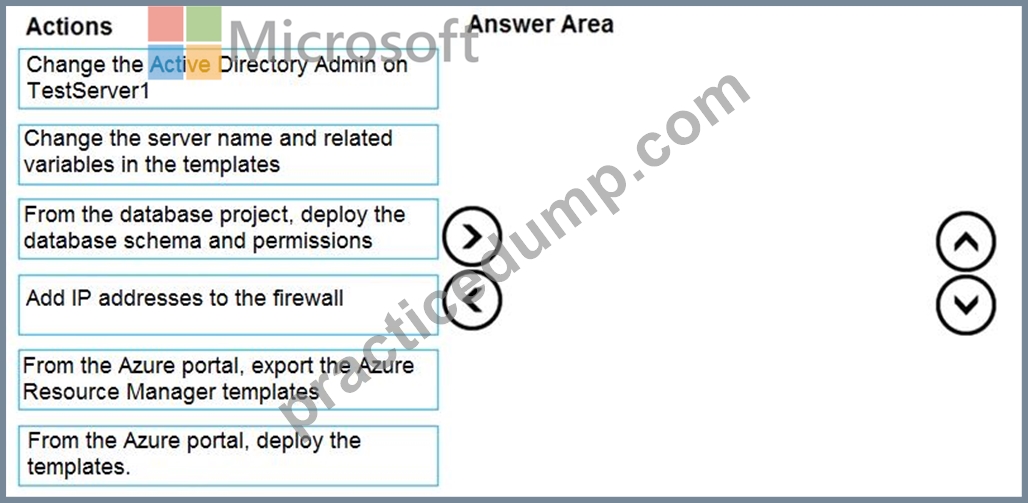
Answer:
Explanation:
1 - From the Azure portal, export the Azure Resource Manager tamplates
2 - Change the server name and related variables in the tamplates
3 - From the Azure portal, deploy the templates.
4 - From the database schema and permissions
NEW QUESTION 111
You have an Azure SQL Database server named sqlsrv1 that hosts 10 Azure SQL databases.
The databases perform slower than expected.
You need to identify whether the performance issue relates to the use of tempdb on sqlsrv1.
What should you do?
- A. Run Query Store-based queries
- B. Review information provided by Query Performance Insight
- C. Review information provided by SQL Server Profiler-based traces
- D. Run dynamic management view-based queries
Answer: D
Explanation:
The diagnostics log outputs tempDB contention details. You can use the information as the starting point for troubleshooting.
You can use the Intelligent Insights performance diagnostics log of Azure SQL Database to troubleshoot performance issues.
Reference:
https://docs.microsoft.com/en-us/azure/azure-sql/database/intelligent-insights-troubleshoot-performance#tempdb-contention
https://docs.microsoft.com/en-us/azure/azure-sql/database/intelligent-insights-use-diagnostics-log
NEW QUESTION 112
You need to provide an implementation plan to configure data retention for ResearchDB1. The solution must meet the security and compliance requirements.
What should you include in the plan?
- A. Configure the Deleted databases settings for ResearchSrvOL
- B. Configure the Advanced Data Security settings for ResearchDBL
- C. Configure the Manage Backups settings for ResearchSrvOL
- D. Deploy and configure an Azure Backup server.
Answer: C
Explanation:
Reference:
https://docs.microsoft.com/en-us/azure/azure-sql/database/long-term-backup-retention-configure This is a case study. Case studies are not timed separately. You can use as much exam time as you would like to complete each case. However, there may be additional case studies and sections on this exam. You must manage your time to ensure that you are able to complete all questions included on this exam in the time provided.
To answer the questions included in a case study, you will need to reference information that is provided in the case study. Case studies might contain exhibits and other resources that provide more information about the scenario that is described in the case study. Each question is independent of the other questions in this case study.
At the end of this case study, a review screen will appear. This screen allows you to review your answers and to make changes before you move to the next section of the exam. After you begin a new section, you cannot return to this section.
To start the case study
To display the first question in this case study, click the Next button. Use the buttons in the left pane to explore the content of the case study before you answer the questions. Clicking these buttons displays information such as business requirements, existing environment, and problem statements. If the case study has an All Information tab, note that the information displayed is identical to the information displayed on the subsequent tabs. When you are ready to answer a question, click the Question button to return to the question.
Overview
NEW QUESTION 113
Note: This question is part of a series of questions that present the same scenario. Each question in the series contains a unique solution that might meet the stated goals. Some question sets might have more than one correct solution, while others might not have a correct solution.
After you answer a question in this section, you will NOT be able to return to it. As a result, these questions will not appear in the review screen.
You have an Azure Synapse Analytics dedicated SQL pool that contains a table named Table1.
You have files that are ingested and loaded into an Azure Data Lake Storage Gen2 container named container1.
You plan to insert data from the files into Table1 and transform the dat a. Each row of data in the files will produce one row in the serving layer of Table1.
You need to ensure that when the source data files are loaded to container1, the DateTime is stored as an additional column in Table1.
Solution: You use a dedicated SQL pool to create an external table that has an additional DateTime column.
Does this meet the goal?
- A. No
- B. Yes
Answer: A
NEW QUESTION 114
Note: This question is part of a series of questions that present the same scenario. Each question in the series contains a unique solution that might meet the stated goals. Some question sets might have more than one correct solution, while others might not have a correct solution.
After you answer a question in this section, you will NOT be able to return to it. As a result, these questions will not appear in the review screen.
You have SQL Server 2019 on an Azure virtual machine.
You are troubleshooting performance issues for a query in a SQL Server instance.
To gather more information, you query sys.dm_exec_requests and discover that the wait type is PAGELATCH_UP and the wait_resource is 2:3:905856.
You need to improve system performance.
Solution: You create additional tempdb files.
Does this meet the goal?
- A. No
- B. Yes
Answer: B
Explanation:
Reference:
https://docs.microsoft.com/en-US/troubleshoot/sql/performance/recommendations-reduce-allocation-contention
NEW QUESTION 115
......
Prepare for your Microsoft certification with the updated PracticeDump DP-300 exam questions: https://drive.google.com/open?id=1iReN3qVl5_yFXwb7R2EzLH7ZSMCFIFVR
Get Latest DP-300 Dumps Exam Questions in here: https://www.practicedump.com/DP-300_actualtests.html